
Things to do in Dangyang
Explore top experiences
Top 10 attractions in Dangyang


Experiences you can't miss in Dangyang
Featured Culture & history in Dangyang
View all Culture & history

5% off
Limited-time sale
FromCAD 234.30CAD 246.64
FromCAD 336.45
Dangyang Today's weatherOvercast 11-15℃
Dangyang weather for the next 2 days11/18: 2-16℃, 11/19: 3-15℃
Free things to do in Dangyang


What travellers say about Dangyang

水漫三楼12 April 2026
5.0
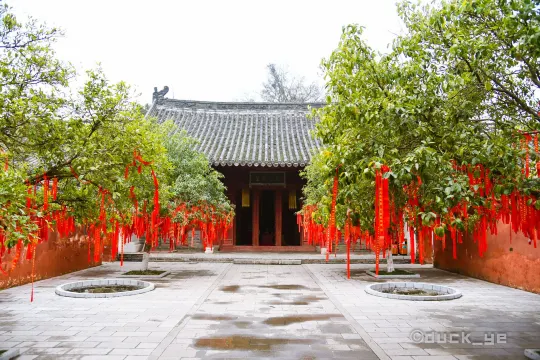
Yuquan Temple is located on the eastern foot of Yuquan Mountain, 12 kilometers southwest of Dangyang City, Yichang City, Hubei Province, with a central scenic area of 8.9 square kilometers. Legend has it that during the Jian'an period of the Eastern Han Dynasty, the monk Pujing built a hermitage here. During the Later Liang Dynasty of the Southern Dynasties, Emperor Xuan of Liang named Yuquan "Fuchuanshan Temple." It was renamed "Yuquan Temple" during the Sui Dynasty. The Mahavira Hall of Yuquan Temple is the largest ancient building in southern China. More than ten large iron artifacts from the Sui Dynasty are displayed in front of the hall; beside the hall is a stone-carved image of Guanyin, said to be the work of Wu Daozi, the Tang Dynasty painter. The existing Yuquan Iron Pagoda is of great value for the study of ancient Chinese metallurgy, metal corrosion prevention, architectural styles, structural mechanics, casting art, and Buddhist history. Yuquan Temple is one of the ancestral temples of the Tiantai School of Buddhism, and was once known as one of the "Four Wonders of the World" along with Guoqing Temple in Tiantai, Zhejiang; Lingyan Temple in Jinan, Shandong; and Qixia Temple in Nanjing, Jiangsu, and was hailed as one of the "Three Famous Mountains of Chu." In 1982, Yuquan Temple and the Iron Pagoda were listed as National Key Cultural Relics Protection Units.
On the ridge of Qinglong Mountain, north of the three gates in front of Yuquan Temple, stands the Yuquan Iron Pagoda. Originally named the "Buddha's Tooth Relic Pagoda," it is commonly known as the "Lengjin Iron Pagoda" or "Thousand Buddha Pagoda." It was cast and built in 1061 (the sixth year of the Jiayou reign of the Northern Song Dynasty) to rebury the relics bestowed by Emperor Gaozong and Empress Wu Zetian of the Tang Dynasty. Modeled after a wooden pavilion, it is octagonal with thirteen levels, standing 16.945 meters tall and weighing 26,472 kilograms. The pagoda consists of four parts: the underground palace, the base, the body, and the spire. The underground palace is a hexagonal vertical shaft made of stone, with a white marble Sumeru pedestal inside. On the pedestal are three layers of stone boxes, which enshrine relics. The base and body of the pagoda are made of cast iron. The eight sides of the Sumeru pedestal are decorated with iron mountains, the sea, the Eight Immortals crossing the sea, two dragons playing with a pearl, and pomegranate flower patterns. At each of the eight corners of the pedestal is a cast a majestic and powerful figure. The flat base of the pagoda body is decorated with a single-hook railing. Each part of the pagoda body has four doors, which are arranged in pairs and staggered in layers.
Yuquan Temple

_U3***2412 March 2025
5.0
Each hall was basically built during the Ming and Qing dynasties, and later damaged to varying degrees and rebuilt or restored, so it has great historical value. The plaque "威震华夏" inside was handwritten by Emperor Tongzhi, and it is the treasure of the museum. It is an original piece of golden nanmu, which is not easy to find.
Guanling Mausoleum
游侠半仙11 May 2023
5.0
I made a special trip to Yuquan Mountain Scenic Area to check in at the Yuquan Temple Iron Tower🗼, a national key cultural relic protection unit. It turned out that it was under repair, which was a pity.
The iron tower was built in the sixth year of Jiayou (1061) in the Northern Song Dynasty. It has 13 octagonal floors.
Pavilion style, cast in sections, nearly 18 meters high, tall and handsome, it is the tallest iron tower in China. The dougongs, flat seats, doors and windows of the pagoda are all imitation of wooden structures, and Buddhist figures or inscriptions are engraved on each side. The base of the tower is engraved with sea ripples, and the lines are smooth and rhythmic. At each corner of the Xumizuo are warriors in armored towers, who are strong and mighty.
Yuquan Mountain Scenic Area

胡团长带你看世界14 November 2021
5.0
Dangyang, a famous historical and cultural city of the Three Kingdoms, is home to many stories about the Three Kingdoms. The most famous legend is the historical story of "Zhao Zilong's battle at Changbanpo, Zhang Fei's roar breaking the Ba Ling Bridge, Liu Bei throwing A Dou, and Guan Yu fleeing to Maicheng". Changbanpo is one of the ancient battlefields of the Three Kingdoms. The Changbanpo Ancient Battlefield Ruins Park tells people the stories of the heroes in this past period, which is worth recommending! 👍👍👍👍👍
Changban Slope

_We***5317 April 2021
5.0
A very good place, the food is very good, it is very convenient for our motorcycle friends, there is a large parking lot, and they can also wash our motorcycles by themselves. The boss is also a motorcycle enthusiast. I chatted with the boss in the evening, and the boss said that he wanted to build this place into a motorcycle reception station, so our motorcycle friends will be blessed. We plan to stay here when we come to Shennongjia for a motorcycle tour next year~
Guanju Riverside


最佳福星5 November 2026
5.0
Definitely worth a visit! Magnificent! The exhibition hall is designed in a dreamlike style, with 3D video displays that make you feel like you've traveled back in time! The park is nestled among lush greenery, and the environment is wonderful! It truly deserves its reputation as a southern chariot and horse formation site comparable to the Terracotta Army in Xi'an! Because it was the off-season, there were fewer people, and the experience was even better than at the Terracotta Army! A must-see for anyone who loves history and culture.
King Chu's Mausoleum

我还是真的橘子28 August 2025
5.0
This is a great place to escape the summer heat. At over 1,300 meters above sea level, the temperature at the foot of the mountain is 38 degrees Celsius, while atop it's only 30 degrees Celsius at noon and 20 degrees Celsius at night—very cool. The sun doesn't burn you, so wear sunscreen. If you drive to the north gate, parking is free. The scenic shuttle bus is very convenient and you can take it anywhere, stopping at your destination. Unlike some tourist attractions, where you have to transfer to an electric bus twice after taking the shuttle bus, this one goes all the way to the destination. The glass skywalk and the roller coaster are perfect for young children, but there's no package deal for the glass slide, so I didn't try it. Grass skiing is a downhill ride on a small slide, not on real grass. The deer in the deer park are also adorable, with free-range baby deer. The horseback riding at the stables was okay, and the horses were very docile. Food and drinks are a bit pricey, typical for tourist attractions. The Hawthorn Tree Love is just average; it's just a quick stop, so don't expect too much. This is primarily a summer getaway and a relaxing getaway.
Bailihuang Tourist Resort Area

Anonymous user16 November 2026
5.0
Finally, we saw the Three Gorges Dam and experienced the rising water level as we passed through the Gezhouba Dam lock by boat. Our tour guide, Yang Hongli, provided excellent explanations and arrangements, explaining everything clearly. Back in Yichang, she even recommended several local restaurants.
Two Dams and One Gorge
Anonymous user7 November 2026
5.0
I originally wanted to book a half-day afternoon tour, but since it's the off-season and there were no tour groups available, I opted for a direct bus. Surprisingly, there were only eight tourists on a comfortable and clean minibus, and they even had a tour guide! Thumbs up for Yichang's high-quality tourism service!
Three Gorges Grand Waterfall
Trip Moments in Dangyang


Popular cities near Dangyang


Frequently asked questions
How can I contact Trip.com customer support?
Get help anytime, anywhere within 30 secondsContact customer support
Can I change or cancel my booking?
Change and cancellation policies vary by attractions and tours. Please check the product details page for more information.
How can I get discounted prices?
Ticket prices may vary between weekdays and weekends, as well as during peak and off-peak seasons. When booking with Trip.com, you can also use Trip Coins to get extra savings. For more tips on booking discounted tickets, please visit Trip.com for the latest information.