


This route is highly niche and in-depth, taking you from underground tombs to a millennia-old city, from the essence of cave art to contemporary works, completing a profound exploration of Dunhuang and even Guazhou's history and art within a single day.
7:30-8:00 AM - Departure
Depart from Dunhuang city in the early morning, heading east.
——
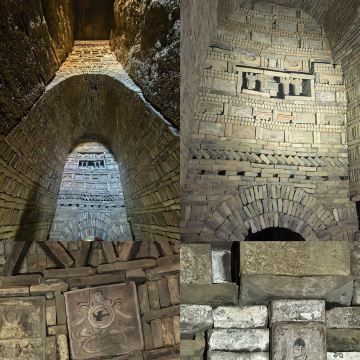
08:30-09:30 Tombs of Western Jin Dynasty | Descend underground and converse with souls from a millennium ago
Not just gazing at murals, but stepping inside the tomb chamber.
Experience highlights: This "jia"-shaped tomb for a husband and wife features a tomb passage approx. a dozen meters long that narrows step by step, like a time tunnel leading to the Western Jin Dynasty. The pictorial bricks in the tomb chamber are well-preserved, covering mythological themes such as Fuxi and Nuwa and the Three Sovereigns and Five Emperors, as well as secular life scenes like kitchens and granaries, and it is hailed as the "underground Mogao Caves."
Interactive experience: Attraction staff will guide travelers into the tomb and provide detailed explanations, allowing close contact with the burial chamber—far more impressive than viewing replicas in a museum. The lines and colors on the mural bricks are more vivid and lively than imagined.
Admission ticket reference: CNY 40/person.
Opening hours: 9:00 AM–7:00 PM.

10:30-12:30 Suoyang City | View "eternity" from the rammed earth city walls
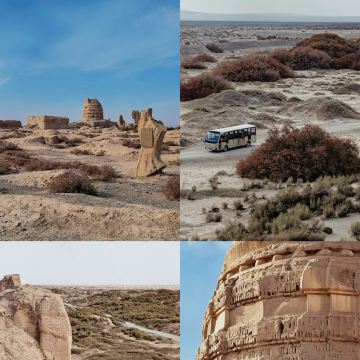
Suoyang City is an ancient city that was first built during the Western Jin Dynasty and flourished in the Tang Dynasty. It is more complete and larger in scale than the ruins of Yang Pass and Yumen Pass.
Historical significance: Suoyang City is a UNESCO World Heritage Site. Its double-layered city walls (inner and outer) and 18 m-high corner bastions still stand today. Ascend the viewing platform to overlook the entire city layout, where the grandeur of Han and Tang dynasty frontier defense comes alive.
Ancient city wall viewing platform: Stand on the city wall and touch the tamarisk branches mixed in the rammed earth—traces of reinforcement from millennia ago.
Temple ruins: Xuanzang preached here during his westward journey. The large stupa in the temple has a base diameter of approx. 11 m and a remaining height of approx. 9 m, with surprisingly well-preserved conditions. Note: This "Temple" is not the Qinghai Temple, but the ruins of a Tang dynasty ancient temple in Guazhou.
Tour method: The attraction covers an extremely large area, and a sightseeing bus (approx. CNY 20/person) is required. It will stop at two points—the ancient city wall and the Ta'er Temple—with approx. 15-20 mins at each point.
Admission ticket reference: Admission ticket CNY 50 + sightseeing bus CNY 20, total approx. CNY 70.
Objective review: Some travelers find the attraction development still immature, with a short stay time and average cost performance; others believe the "authenticity" here is more impressive than yangguan and yumenguan.

14:00-16:00 Yulin Grottoes | The "hidden gem" of Dunhuang art
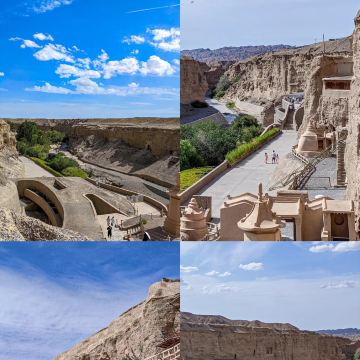
Yulin Grottoes is hidden deep in a canyon with far fewer travelers than Mogao Caves, yet its mural artistry is equally superb. It has been hailed by "China National Geography" as "the second greatest treasure trove of mural art after Mogao Caves".
Difference from the Mogao Grottoes: The Mogao Grottoes showcase the "overall" grandeur, while the Yulin Grottoes highlight the "intricate" details. The on-site guides are mostly professionals from the Dunhuang Academy, offering commentary so detailed they point out every single line to you.
Regular caves vs special caves:
Regular caves (admission ticket CNY 40): 5 caves are open, featuring renovated statues from the qing dynasty and partial murals from the western xia and song dynasties. Some travelers commented "a bit plain".
Special caves (highly recommended): This is the soul of the Yulin Grottoes. Cave 2 "Water-moon Guanyin", Cave 3 "Thousand-armed and thousand-eyed Guanyin", and Cave 25 "Illustration of the Sutra of the Buddha of Immeasurable Life" — recognized treasures of Dunhuang art.
Special cave prices: Cave 2 CNY 100, Cave 3 CNY 150, Cave 4 CNY 100, Cave 25 CNY 200. Custom combinations available.
Schedule: The special caves have fixed time slots daily. During peak season, the last session stops selling tickets at around 3:30 PM, so it is recommended to arrive before 2:00 PM. Each special cave guide lasts about 30 minutes, while regular cave guides take approximately 5-7 minutes per cave.
Opening hours: peak season (May–Oct) 9:00 AM–5:30 PM, last ticket sale at 4:30 PM.

16:30-17:30 Gobi sculpture art corridor | "Modern mirage" on the Gobi
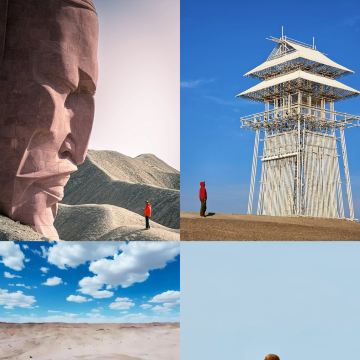
The Gobi sculpture art corridor features modern steel structures standing on the desert, "translating" the pavilions from ancient murals of a thousand years ago.
"Son of the earth": Created by professor Dong Shubing from Tsinghua University, this giant infant lies prone on the Gobi Desert, measuring 15 m in length and 4.3 m in height. It is recommended to photograph from different angles, as the contrast against the sandy mountain backdrop is striking.
Boundless: Dong Shubing's second work, inspired by the architectural style of the High Tang Dynasty sutra illustration in Cave 25 of the Yulin Grottoes, is constructed with approx. 6,300 steel pipes. From afar, it resembles a mirage in the Gobi Desert, while up close, it is a precise modern artwork.
Hanwu Xiongfeng Sculpture: a red sandstone-carved profile picture of Emperor Wu of Han, set against undulating sand dunes, creating a majestic atmosphere.

5:30-7:00 p.m. Return to Dunhuang
On this day, you'll experience four eras of "Dunhuang expression" underground, above ground, inside caves, and across the Gobi Desert, with extraordinary information density. The return journey offers perfect quiet for reflection.