


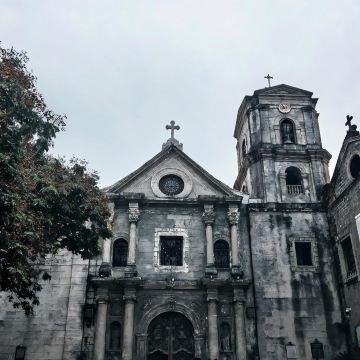

▲ Archdiocesan Shrine of Nuestra Señora de la Consolación y Correa - San Agustín Church facade and UNESCO plaque - the facade is austere to the point of severity: gray-green volcanic stone, symmetrical columns, a cross at the top, lacking the grandeur of the Florence Cathedral yet bearing a silence that has "endured time." The plaque reads UNESCO World Heritage Site — in 1993, it was inscribed on the list along with four other colonial churches in Manila, with just one sentence stating its significance: it is the oldest surviving stone church in the Philippines and a living fossil of Spanish colonial architecture in the Far East.


▲ A nave that has stood for four centuries - the elongated nave resembles a time tunnel: the checkered marble floor bears the footsteps of centuries, the wooden benches have seated colonists, missionaries, soldiers, and now travelers holding up their phones to take photos. The sacred image on the main altar at the end has witnessed the Philippines transform from a colony to a republic, seen Intramuros nearly razed to the ground during World War II — yet it alone remains standing in its place.


▲ Dome trompe-l'oeil ceiling - the moment you look up, gold engulfs your vision. This is not a chapel of some European duke, but the interior of a church in the City of Manila that has withstood 400 years of earthquakes, typhoons, and wars without collapsing. Baroque reliefs unfold layer by layer across the dome, and crystal chandeliers have hung at this height since its completion in 1607—it's said the Spaniards condensed all their imaginings of the Americas and Asia into this gilded vault.


▲ The main altar is the magnificent heart of the entire church—the golden retablo (altarpiece) stands over ten zhang tall, with stained glass casting dappled light in the afternoon. Here rests the relics of Saint Augustine, and it was once an expensive investment of faith by the Spanish royal family in the Far East. Behind every gilded pattern lies silver, spices and missionary routes that crossed oceans; every religious statue reflects the Spanish obsession with "transplanting" European civilization to the tropical archipelago.


▲ The long corridor is lined with religious oil paintings from the colonial era, while the words "SAN AGUSTIN CHURCH, LOVE FOR GOD" on the wall seem like a belated narration. This place once served as a scriptorium, confessional, and sanctuary for monks. During the 1945 Battle of Manila, Intramuros was nearly flattened by bombings, and nearby Fort Santiago was burned to ruins. Yet this stone corridor, with walls several meters thick, stubbornly kept the war at bay — secrets were never in the paintings on the walls, but in the walls themselves.


▲ The moss and cracks on the stone fountain at the monastery's center remember everything. In 1571, Spanish colonizer Miguel López de Legazpi established a stronghold on Luzon Island, and this courtyard was the core of the earliest "city within a city." Here, monks drew water, prayed, stored books, and witnessed four centuries of the Philippines as Catholicism's Asian bridgehead. The fountain does not speak, yet it understands time better than any history book.

▲ The arched windows of the vaulted exhibition hall at the Museum of St. Augustine are inlaid with capiz shells unique to the Philippines. Sunlight filters through, casting a soft glow unlike that of glass. Here, colonial-era maps, prints, and religious artifacts are displayed. As you walk down this corridor, you suddenly grasp the true meaning of "standing strong for 400 years"—it's not just the survival of a building, but the survival of a layered civilization. Spanish stone, Chinese porcelain, local shells, and American silver all bask in the same light.


▲ This radial gold artifact in the display case is called a monstrance, a sacred vessel used in Catholic Mass to display the consecrated host. The gemstones inlaid on it and the intricate filigree craftsmanship faintly reveal the prosperity of 17th-century Manila as a trade hub connecting China, Mexico, and Spain. This is no ordinary relic — it was once held high during countless plagues, uprisings, and festivals, serving as a dazzling spiritual token of the colonial era.

▲ The vaulted masonry burial chamber has walls densely lined with niche tombs on three sides, with a sarcophagus-style memorial platform at the center. During the colonial era, only two types of people were buried inside churches: monks who made significant contributions to the church, and Spanish officials and colonists granted honors. The Latin epitaphs on the walls record those who have rested here from the 17th to the 19th century.