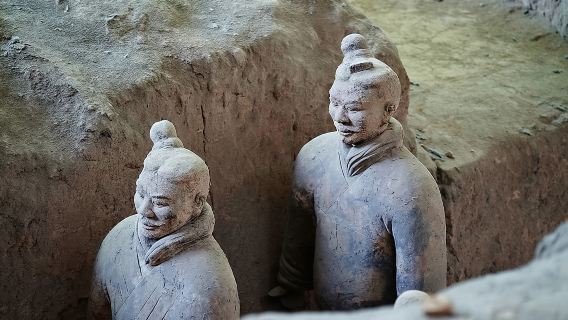
Based on the Jingyang Fu Tea culture, the Fu Tea Cultural Industrial Park has been established to drive the economic and tourism development of surrounding villages and towns, forming the Fu Tea Town that integrates Fu Tea culture, Guanzhong folk culture, and Guanzhong lifestyle culture.

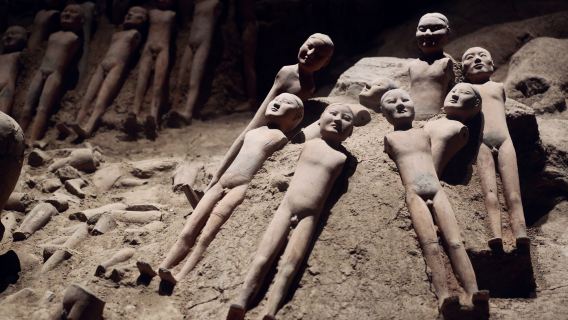
Emperor Jing of Han, Liu Qi, was the fourth emperor of the Western Han Dynasty. Together with his father, Emperor Wen of Han, Liu Heng, they created the golden age of Chinese autocratic society known as the "Rule of Wen and Jing." He passed away in the Weiyang Palace of Chang'an in the third year of the Houyuan era (141 BC) and was buried in the Yangling Mausoleum.

The Yangling Mausoleum was initially constructed in the fourth year of the Former Yuan era (153 BCE). From the time Emperor Jing of Han began building the mausoleum until Empress Wang was buried there, the construction of Yangling spanned 28 years. During the Qianlong reign of the Qing Dynasty, Bi Yuan, the governor of Shaanxi, erected a naming stele for the mausoleum. Between 1906 and 1910, Japanese scholar Adachi Kiroku, a lecturer at Shaanxi Higher School, conducted preliminary archaeological surveys of the Western Han imperial tombs, including Yangling, as well as the ruins of Han Dynasty Chang'an City.
Due to the unique nature of travel products, seniors aged 79 and above must contact the travel agency's customer support before placing an order. Any losses incurred from direct bookings without prior communication will be the traveler's responsibility. Please note that travelers aged 79 and above should not place orders as group tours cannot be arranged for this age group. We appreciate your understanding.