Hanyin

Things to do in Hanyin

Search attractions or local attractions & tours
Search

Explore top experiences

Top 10 attractions in Hanyin

View all Attractions
Emperor Qinshihuang's Mausoleum Site Museum
2026 Global 100 - Best Things to Do

Emperor Qinshihuang's Mausoleum Site Museum

10
4.7/5
150k reviews
Emperor Qinshihuang's Mausoleum Site Museum (Terracotta Army), also known asEmperor Qinshihuang's Mausoleum Site Museum, Terracotta Army. It isMausoleum of the First Qin Emperor's burial pit, andMausoleum of the First Qin EmperorTogether they form:Emperor Qinshihuang's Mausoleum Site Museum. Emperor Qinshihuang's Mausoleum Site MuseumIt has long been known as the Eighth Wonder of the World. The more than one thousand pottery soldiers and horses unearthed here are all different in appearance and vivid in expression. They are a shining pearl in the history of ancient Chinese sculpture art and have been hailed as "one of the great discoveries in the archaeology of the twentieth century." Historical background Qin Shi Huang began constructing the mausoleum as soon as he ascended the throne at the age of 13. Nearly 720,000 laborers were employed over a period of 38 years, making it a massive undertaking. The mausoleum was still unfinished when Qin Shi Huang died, and it took more than a year of continued construction under Qin Er Shi, Hu Hai, before it was finally completed. Legend has it that Emperor Qinshihuang spent countless manpower, material resources, and financial resources to build an underground palace for himself, and the Emperor Qinshihuang's Mausoleum Site Museum serves as its guardians. The Terracotta Army of Emperor Qinshihuang's Mausoleum Site Museum can be regarded as a typical example of replacing human sacrifice with figurines. The reason why the terracotta warriors reached such a high level in scale and realism is inseparable not only from the wisdom of the craftsmen but also from the will of this emperor. In March 1974, farmers from Xiyang Village in Lintong District, Shaanxi Province, accidentally discovered some fragments of pottery figurines while digging a well. After more than a year of exploration and trial excavation by archaeologists, it was confirmed to be a large-scale pit of figurines — the world-renowned Pit 1 of the Emperor Qinshihuang's Mausoleum Site Museum. In April and May 1976, Pits 2 and 3 of the Emperor Qinshihuang's Mausoleum Site Museum were discovered on either side of Pit 1, each differing in size, shape, and unearthed artifacts. Some scholars believe that Pit 3 served as the command center directing Pits 1 and 2, known in ancient times as a "military tent." Emperor Qinshihuang's Mausoleum Site Museum, built on the site of the Terracotta Army pits, officially opened in 1979. The main attractions include Terracotta Army Pits 1, 2, and 3, the bronze chariots and horses exhibition hall, and related temporary exhibitions. Emperor Qinshihuang's Mausoleum Site Museum offers visits to three Terracotta Army pits, including Pit 1, as well as the unearthed artifacts exhibition hall, the bronze chariots and horses exhibition hall,Mausoleum of the First Qin Emperor. The Emperor Qinshihuang's Mausoleum Site Museum excavated here can be divided into general figures, warrior figures, charioteer figures, and others according to differences in costume, expression, and hairstyle. Each figure has a different face shape, hairstyle, posture, and expression. The figures and horses were originally painted, but due to subsequent burning and soaking, most of the paint has peeled off and discolored. Pit 1 Pit 1 in the attraction was among the earlier ones to be excavated. The pit measures approximately 230 m from east to west and 62 m from north to south. Based on the arrangement density of the pottery figurines and horses unearthed during trial excavation, it is estimated that approximately 6,000 pottery figurines and horses are buried in Pit 1 of the Emperor Qinshihuang's Mausoleum Site Museum, along with a large number of bronze weapons. Pit No. 1 is also one of the most impressive exhibition halls that have been pieced together so far. You can see a massive army of terracotta soldiers standing in the pit in various poses, and it is said that there are more than thirty styles of beards alone. If you look closely, every soldier is lifelike, and everything from the armor to the facial expressions, from the weapons to the lines on the palms, is astonishing. Pit 2 and Pit 3 Pit 2 and Pit 3 are located on either side of Pit 1. Like Pit 1, they contain nearly 2,000 life-sized pottery figurines and horses. There are different troop types such as charioteers, cavalry, and infantry, arranged in neat and orderly formations. Although they are less awe-inspiring than Pit 1, each pit has a different troop arrangement and function, so they are equally worth seeing. Emperor Qinshihuang's Mausoleum Site MuseumThe shaping is based on real life, with delicate artistic techniques. The terracotta warriors have different costumes and expressions, showing distinct personalities and strong characteristics of the era. The bronze weapons unearthed in the pits include swords, pi, spears, ge, ji, shu, crossbow mechanisms, and a large number of arrowheads. Most of the weapons remain sharp after more than two thousand years, indicating that a high level of metallurgical technology had already been achieved at that time.China · Xi'an
Shaanxi History Museum
2026 Asia 100 - Family-friendly Attractions

Shaanxi History Museum

9.5
4.8/5
35.2k reviews
Shaanxi History Museum is a large modern museum built after China's reform and opening up and officially opened in 1991. The building was designed by architect Zhang Jinqiu and adopts a Tang-style architectural layout of "central hall and four corner towers," with a symmetrical central axis and a clear hierarchy of primary and secondary structures; in 2016 it was included in the first batch of the "Chinese Architectural Heritage of the 20th Century" list. Shaanxi was once the political center of dynasties such as the Zhou, Qin, Han, and Tang, and the museum's collection spans a million years of history, covering categories such as Shang and Zhou bronzes, pottery figurines of successive dynasties, Han and Tang gold and silver wares, and Tang tomb murals, with a total of over one million items. The permanent exhibition "Ancient Civilization of Shaanxi" follows a chronological main line and presents the historical process from prehistoric Lantian Man to the eve of the Opium War across three galleries, with the Zhou, Qin, Han, and Tang periods as the focus. The east and west sides of the central hall each host a thematic exhibition: on the west side, "Treasures of the Great Tang: Hejiacun Hoard Unearthed Artifacts Exhibition" concentrates on fine gold and silver wares of the High Tang, while on the east side, the "Tang Dynasty Mural Treasures Gallery" displays authentic murals removed from Tang tombs, with subjects covering figures, architecture, ceremonial guards, and more, making it a uniquely distinctive category of the museum's collection. Among the many artifacts in the museum, several are particularly notable. The agate cup with gold-inlaid beast head, from the Hejiacun hoard, is carved from a single piece of banded agate into the form of a curved-horn beast head, resembling Central Asian rhyton cups, and is one of the first batch of cultural relics prohibited from being exhibited abroad. The tri-color glazed camel carrying musicians figurine vividly recreates the lively scene of musicians playing and singers performing on a camel's back, with bright glaze colors and figures with distinct expressions. The Empress's Seal is made of Western Han Hetian mutton-fat jade and carved with a chi-tiger knob, and is the only known actual jade seal of a Han dynasty empress discovered to date. In addition, the gilt silver flask with a dancing horse holding a cup design, the celadon ewer with an overhead handle and bottom-filling design, and the black-glazed oil-spot bowl each have their own distinctive features. The gold and silver wares unearthed from the Hejiacun hoard are concentrated in the thematic gallery and are a highlight of any visit; visitors are advised to allow time to examine them closely.China · Xi'an
Xi'an City Wall
2026 Global 100 - Night Attractions

Xi'an City Wall

8.8
4.6/5
62.9k reviews
Xi'an City Wall, also known as the Xi'an Ming City Wall, is an ancient city wall defense system encircling the old city of Xi'an from the Ming and Qing dynasties. The main body of the existing wall was built during the Hongwu period of the Ming Dynasty, expanded on the foundation of the imperial city of Chang'an from the Sui and Tang dynasties, and has undergone multiple renovations since then, remaining well preserved to this day. The wall is roughly rectangular in plan, with a perimeter of about 14 km, and the area it encloses is the old city of Xi'an. The wall is about 12 m high, about 15 to 18 m wide at the base, and about 12 to 14 m wide at the top. The top of the wall is broad and flat, allowing visitors to cycle or stroll along it while overlooking the scenery inside and outside the city. The defensive system of the wall consists of the wall body, city gates, barbicans, bastions, corner towers, and the moat. Nearly a hundred bastions were built along the outer face of the wall, spaced about 120 m apart, precisely within bow-and-arrow range, reflecting the defensive wisdom of the cold weapon era. There is a corner platform at each of the four corners, among which the southwest corner platform is circular, forming a striking contrast with the other three square corner platforms—a unique form rarely seen among surviving ancient city walls. The moat outside the wall encircles the entire city, together with the wall forming a complete defensive layout. The wall currently has 18 city gates, among which Yongning Gate (South Gate), Anding Gate (West Gate), Anyuan Gate (North Gate), and Changle Gate (East Gate) are the four main gates originally built in the Ming Dynasty. Each main gate features three tiers of gate towers—the gate control tower, arrow tower, and main tower—forming a layered barbican defense. Yongning Gate is the one that has been in use the longest, with a history dating back to the Sui Dynasty, and is also the one whose form is relatively well preserved. The section of the wall at Hanguang Gate encloses the remains of the Sui and Tang imperial city, with a site exhibition that offers an intuitive sense of the wall's layered history spanning over a thousand years. Cycling a full loop around the city on the wall is a popular experience, taking about one and a half to two hours in total. Ascending the wall in the evening allows you to take in both the traditional architecture inside the city and the modern urban skyline outside, with the wall and moat set off beautifully against the glow of the setting sun.China · Xi'an
Huaqing Palace
No. 5 of Global Traveller-Picked Attractions in Xi'an

Huaqing Palace

8.7
4.6/5
33.7k reviews
Huaqing Palace attraction is located 30 km east of Xi'an, adjacent to the Terracotta Warriors. Renowned for its timeless hot spring resources and numerous historical events, it has become an iconic cultural tourism attraction of Tang Dynasty palaces in China. Palace scenic spots Huaqing Palace boasts a long history, serving as an imperial retreat for emperors from the Zhou, Qin, Han, Sui, and Tang dynasties. The palace features cultural zones like the Tang Imperial Hot Spring Relics Museum, the Xi'an Incident site—Five-Room Hall, Nine Dragon Lake and Lotus Lake scenic areas, and the Tang Pear Garden Museum. Notable architectural complexes include Feishuang Hall, Wanshou Hall, Changsheng Hall, Huanyuan Garden, and Yuwang Hall. The stele of "hot spring ode" Mount Li hot springs, developed early and favored by emperors throughout history, enjoy the reputation of being "the imperial hot springs under heaven." As far back as the Yangshao culture period 6,000 years ago, the ancient Jiangzhai people began utilizing these springs. With their profound cultural heritage spanning millennia, Mount Li hot springs represent an indispensable part of Chinese historical culture. The stele of hot spring ode in the attraction stands 154 cm tall, 72 cm wide, and 19 cm thick, featuring a coiled dragon design and a trapezoidal base. Engraved by Yuan Chang, the governor of Yongzhou during the Northern Wei Dynasty, the inscription reads, "The hot spring is nature's prescription and the primordial healer of the universe. People from all nations and those suffering from ailments come with provisions to seek relief in its waters." This stele is the earliest surviving written artifact at Huaqing Palace. Tang Imperial Hot Spring Relics Museum This is the site of the bathing pool described in the "Song of Everlasting Sorrow" where Yang Guifei emerged from her bath. After the An Lushan Rebellion, little remained of the original structure. In 1982, while constructing the "Guifei Pavilion," the Lintong County Government accidentally discovered the ruins of a Tang Dynasty bathing pool. After excavation and restoration, the Huaqing Palace imperial hot spring ruins museum was established. This small yet exquisitely designed pool measures 3.6 meters east-west and 2.9 meters north-south, with an oval-like shape. The pool walls are entirely built with bluestone slabs, featuring a two-tiered terrace structure composed of 18 arched stone sections. Inside the pool lies a dedicated bathing stone for Yang Guifei, engraved with the character "Yang." At the center of the pool bottom is a 10 cm diameter water inlet. A white marble lotus pedestal was unearthed here, connecting to both a showerhead above and ceramic water pipes below that linked to the main water source. Due to natural pressure, hot spring water would spray outward through the lotus showerhead, creating a mist effect remarkably similar to modern showers. Adjacent to the Guifei Pool to the east lies Emperor Xuanzong's exclusive imperial hot spring. During the Tang Dynasty, the Nine Dragon Hall stood above this pool, featuring nine white jade-carved dragons spouting water outside. This pool's surface resembles a realistic lotus shape, hence its alternate name "Lotus Pool." Xi'an incident site The five-room hall at the Xi'an incident site in Huaqing Palace is where the Xi'an incident took place. To this day, the glass windows and walls of the five-room hall still bear bullet marks from the fierce battle during the military remonstrance. The desks, chairs, beds, sofas, tea sets, stoves, carpets, telephones, and other office items in each room are replicated and arranged according to their original appearance. Historical events: Beacon fire to deceive the feudal lords In 779 BC, King You of Zhou obtained the beautiful Bao Si, yet she never smiled. To solve this, the king conspired with the treacherous minister Guo Shifu and lit the beacon fires at the Huaqing Palace attraction. The feudal lords across the land saw the signals.Beacon fireHe quickly led his troops to rescue the king, but King You told the feudal lords, "I lit the beacon fires just to make my queen laugh," upon which Bao Si burst into laughter. The feudal lords arrived valiantly but left resentfully. Seeing King You's incompetence and the people's discontent, the Quanrong tribe seized the opportunity to launch an attack. As the enemy troops approached the mountain, King You urgently raised the beacon fires.Beacon fireHe mobilized troops, but none of the feudal lords came to his rescue. King You fled with Bao Si toMount LiHe was later killed by the Quanrong tribe, leaving behind historical anecdotes such as "a smile worth a thousand gold," "losing the kingdom for a smile," and "playing with beacon fires to deceive the feudal lords." And this beacon tower at Huaqing Palace attraction towers at an altitude of 913.6 m.Mount LiThe beacon tower at Huaqing Palace attraction on the first peak of Xixiu Ridge. Su Dongpo composing poetry at Mount Li During the Jiayou era of the Northern Song Dynasty, the Lishan hot springs, meticulously restored by Liu Ziyong and others, became breathtakingly beautiful, attracting crowds of visitors who composed poems and essays to express their nostalgia. Among the countless poetic works, the emerging literary giant Su Shi stood out with his masterpieces like "Lady of Guo's night outing" and "Lishan" during his visit to the hot springs. Xi'an incident The Xi'an incident, also known as the "double-twelfth incident". Zhang Xueliang and Yang Hucheng launched a mutiny at Huaqing Palace, detaining the then chairman of the Military Commission of the National Government. Performance items You can watch a large-scale dance drama at the attraction. ▲ The Song of Everlasting Sorrow is China's first large-scale live historical dance drama created by Shaanxi Tourism Group. Based on Bai Juyi's timeless poem of the same name, it fully utilizes the attraction's resources and employs high-tech stage lighting to combine historical storytelling with live performances, recreating the love story of Emperor Li Longji and Yang Guifei at Huaqing Palace over 1,300 years ago. ▲There is also the historical adaptation "12-12 Xi'an Incident," which vividly and authentically recreates the lesser-known details of the "Xi'an Incident."China · Xi'an
Mount Hua
2026 Asia 100 - Best Things to Do

Mount Hua

8.7
4.7/5
55.5k reviews
Mount Hua, known as the "Western Great Mountain" in ancient times, is one of China's Five Great Mountains. Located in Huayin, Shaanxi Province, it is also elegantly called "Taihua Mountain." The "Hua" in both "Zhonghua" and "Huaxia" originates from this mountain. "Steep and perilous" are the essence of Mount Hua's scenery, and the saying "there has always been only one path up Mount Hua" precisely describes its steepness—the Plank Road in the Sky, the Sparrowhawk Turn, the Thousand-Foot Precipice, the Hundred-Foot Gorge, the Laojun Plow Ditch, and other perilous sights leave every visitor awestruck. The Mount Hua attraction covers a vast area, including the main peak attraction, the Western Great Mountain Temple attraction, and the Xianyu attraction, among which the main peak attraction is the core, encompassing the five main peaks—east, south, west, north, and center—as well as the classic "Mount Hua Valley" climbing trail. The five main peaks each have their own distinctive features. The East Peak, at an elevation of approx. 2,100 m, has the open and expansive Chaoyang Terrace at its summit, making it an excellent spot for watching the sunrise, and is therefore also known as Chaoyang Peak; the natural stone patterns on the cliff face along the side of the peak resemble a giant palm print—this is the Huayue Immortal Palm, listed since ancient times as one of the Eight Views of Guanzhong. The West Peak, at an elevation of approx. 2,080 m, is named Lotus Peak because the giant rock at its summit resembles a lotus flower; the Cuiyun Palace, the Axe-Split Rock, and the Self-Sacrifice Cliff are scattered across it, and the myth of Chenxiang splitting the mountain to save his mother is said to have originated here. The South Peak, at an elevation of over 2,150 m, was called the "head of Mount Hua" by the ancients; it consists of two summits—Songgui Peak and Luoyan Peak—with a sheer cliff dropping straight down on one side. The North Peak, at an elevation of approx. 1,600 m, is also known as Yuntai Peak; it stands isolated and towering with precipitous drops on all four sides, and the story of "Taking Mount Hua by Strategy" took place here; the peak features views such as the Zhenwu Hall and the Jiaogong Stone Chamber. The Central Peak lies at the center of the East, West, and South Peaks, with serene and lush vegetation; on the peak is the Jade Maiden Shrine, said to be the place where Nongyu, daughter of Duke Mu of Qin during the Spring and Autumn period, cultivated herself, hence it is also known as Jade Maiden Peak. The Plank Road in the Sky is located on the mountainside east of the South Peak. It was built by the Yuan Dynasty Taoist He Zhizhen, who embedded stone stakes into the cliff face and laid wooden planks. At the end of the plank road, visitors can see Hezu Cave, where he cultivated himself. Visitors must press close to the cliff, hold the iron chains, and step on the wooden planks while moving sideways slowly—an extremely thrilling experience. The ridge of Canglong Ridge is as narrow as a blade, flanked by bottomless chasms, and walking on it makes one's heart race and vision blur. Golden Lock Pass is the vital gateway to the East, West, South, and Central peaks. Taoists believe that passing through this pass marks entry into a fairyland, and there is a folk saying: "Once past Golden Lock Pass, you enter another realm."China · Huayin
Xi'an Museum
No. 1 of Family-friendly Attractions in Shaanxi

Xi'an Museum

8.5
4.6/5
4.1k reviews
Xi'an Museum is a modern comprehensive museum built upon the cultural relic protection site—the ruins of the Tang Dynasty Jianfu Temple and its iconic structure, the Small Wild Goose Pagoda. It integrates cultural relic collection and protection, academic research, exhibition and display, social education, and garden leisure. Its core area is the location of the original Tang Dynasty royal temple, Jianfu Temple, while the precious and striking historical relic existing within the temple—the Small Wild Goose Pagoda—has become the museum's unique landmark and soul. Therefore, the Jianfu Temple ruins and the Small Wild Goose Pagoda are not only the foundation and core carrier for the establishment of Xi'an Museum, but also important outdoor historical exhibition areas and focal points for visitors. The main building of the museum is located on the north side of the ancient temple ruins. The three elements (ancient temple ruins, ancient pagoda, and modern museum building) are organically integrated, jointly forming a unique cultural space that combines "museum, pagoda, temple, and garden," vividly showcasing the historical context of Xi'an from ancient times to the present. Xi'an Museum officially opened to the public on May 18, 2007. Its establishment aims to comprehensively showcase the glorious history and splendid culture of Xi'an (ancient Chang'an) as the capital of thirteen dynasties, filling the gap of a comprehensive museum of Xi'an's urban history. Collection highlights: The museum houses over 100,000 precious cultural relics from various historical periods of Xi'an. The collection spans from prehistoric times to the Ming and Qing dynasties, with particular emphasis on artifacts from the prosperous dynasties of Zhou, Qin, Han, and Tang, including bronze ware, jade articles, gold and silverware, ceramics, murals, stone steles, epitaphs, and Buddhist statues, systematically reflecting the political, economic, cultural, social life, and foreign exchanges of the ancient capital Chang'an. Main exhibition: The permanent exhibition "Ancient capital Xi'an" takes the urban development history of Xi'an as the main thread, showcasing the evolution and achievements of Xi'an as a capital (Zhou Fenghao, Qin Xianyang, Han Chang'an, Sui-Tang Chang'an) and a prefectural city (Song, Yuan, Ming, and Qing dynasties) through a large number of precious cultural relics, models, charts, and multimedia means. Unique environment: The museum's greatest feature lies in its surroundings. Travelers can not only visit modern exhibition halls but also stroll through the expansive heritage park encompassing the Small Wild Goose Pagoda, the ancient architectural complex of Jianfu Temple (including structures like the Ming dynasty bell tower housing a Jin dynasty ancient bell), an ancient stone sculpture art exhibition area, and garden views—experiencing the charm of the millennia-old capital at its historical site. The view of "morning bells at the Wild Goose Pagoda" is particularly renowned. Functional positioning: The museum is not only an important center for cultural relic collection, research, and display, but also an urban cultural park where citizens can relax, entertain, and immerse themselves in history and culture, undertaking significant social education and cultural exchange functions.China · Xi'an
Grand Tang Mall
2026 Global 100 - Night Attractions

Grand Tang Mall

8.5
4.5/5
2.3k reviews
Grand Tang Mall is a large-scale Tang-style architectural pedestrian street in Xi'an's Qujiang New District, built around the Giant Wild Goose Pagoda. It stretches from the Xuanzang Square at the foot of the pagoda in the north to the Tang City Wall Ruins Park in the south, connected by a approx. 1500 m central axis view boulevard running north-south. The boulevard itself resembles an open-air sculpture gallery, featuring themed sculptures arranged sequentially from north to south: Buddhist culture of the Tang Dynasty, Tang heroes, the Zhenguan era governance, Empress Wu's procession, and the Kaiyuan heyday. Statues of eminent monks like Xuanzang and Jianzhen stand at the front, followed by Tang luminaries such as Li Bai, Wu Daozi, Sun Simiao, and Lu Yu in the middle section, with ceremonial processions of Emperor Taizong, Empress Wu Zetian, and Emperor Xuanzong concluding the display. Walking through this boulevard is akin to reading a three-dimensional history of the Tang Dynasty. The block connects three themed squares from north to south—Xuanzang square, Zhenguan square and Kaiyuan square—with Tang-style pavilions lining both sides. Among them are four cultural venues: Xi'an concert hall, Shaanxi grand theater, Xi'an art museum and Qujiang cinema. Enjoying concerts, visiting exhibitions and shopping for photos can all be arranged along the same route. By day, admire the architecture and sculptures, but the real highlight of this street comes after nightfall—when the lights come on, the Tang-style pavilions glow with radiant colors, and the entire street seems to recreate the splendor of the Tang Dynasty. The area features year-round immersive street performances: a "Tumbler Girl" in Tang attire leans in to hold hands with travelers as she spins; Fang Xuanling and Du Ruhui from the "Secret Box of the Tang Dynasty" appear, posing riddles and bantering, with clever answers from selected travelers drawing cheers from the crowd; Hu Xuan dances and Tang-era music performances compete in a colorful parade; and actors dressed as the "Poet Immortal" may challenge you to a verse duel at any moment—strolling around, you might stumble upon a performance. This place gathers trending attractions, highlighting dazzling colors, fantasy, and a tech vibe. Through large-scale installations, it creates a stylish and dynamic interactive experience center, offering a sought-after photo spot for trendy young crowds. In the family-friendly tech zone, scene-based displays and hands-on actions spark children's imagination and creativity, combining play with skill development and experiential gains—making it an ideal destination for family-friendly fun.China · Xi'an
Xi'an Bell Tower
2026 Global 100 - Night Attractions

Xi'an Bell Tower

8.2
4.5/5
25.4k reviews
Xi'an Bell Tower is one of the larger and well-preservedBell tower, originally built in 1384, during the Hongwu reign of the Ming Dynasty,Bell towerLocated in the heart of Xi'an, it is one of the landmarks of the ancient city, radiating east, south, west, and north streets from its center, connecting to the east, south, west, and north gates of the Xi'an city wall respectively. The Xi'an Bell Tower was originally located on Guangji Street in the west. As the city center shifted eastward, it was relocated toDrum towerEast side, today's location. The Xi'an Bell Tower features a typical Ming Dynasty architectural style, with a square brick-and-stone base at the bottom and a triple-eaved pyramidal roof structure at the top, covered with dark green glazed tiles. The gilded pinnacle at the roof's apex is particularly striking under sunlight. Each side of the base has a central arched doorway approx. 6 m high, which were interconnected and once served as passageways for the intersection of four major streets—east, south, west, and north—allowing pedestrian and vehicular traffic. These doorways are now sealed, with a traffic roundabout built around them and an underground pedestrian passage. The entrance to the Xi'an Bell Tower is located within this underground passage, accessible via a spiral staircase. Inside the tower, there is a replica of the "Jingyun Bell," whose original was cast in the second year of Emperor Ruizong's Jingyun era (711 AD) during the Tang Dynasty and is now housed in the Xi'an Beilin Museum. Standing on the Xi'an Bell Tower, you can see the four main streets extending east, south, west, and north from the Xi'an Bell Tower. Around the Xi'an Bell Tower, there are bustling commercial areas and not far awayDrum towerTravelers can also enjoy wonderful historical performances when visiting the Xi'an Bell Tower.China · Xi'an

Experiences you can't miss in Hanyin

Hanyin Today's weatherOvercast 10-17℃
Hanyin weather for the next 2 days11/5: 14-18℃, 11/6: 11-17℃

Free things to do in Hanyin

What travellers say about Hanyin

user-avatar
Nancyhr050415 March 2023
5.0
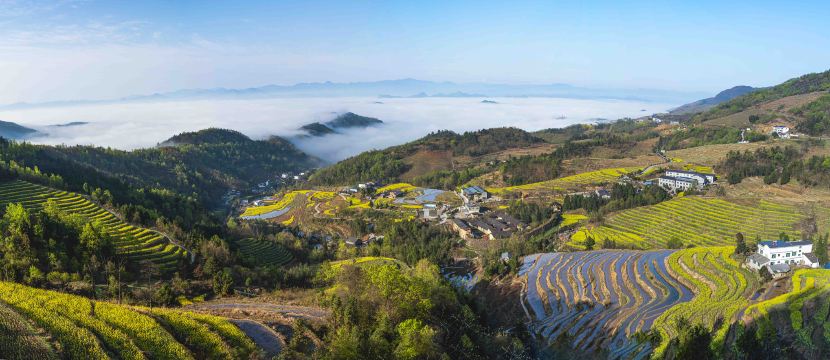
During the Qianlong period of the Qing Dynasty, the Wu family from Shanhua County, Changsha Prefecture, Hunan Province moved to Hanyin, Shaanxi Province, and began to reclaim wasteland, build farmland, dikes and build embankments. For more than 200 years, the Fengyan Ancient Terraces have been in use to this day.

Fengyan Ancient Terraced Fields

user-avatar
_We***853 November 2026
5.0
The trip to Qin Shi Huang's Mausoleum was absolutely worthwhile! Our guide, Sister Juanzi, was professional and patient, providing detailed and engaging explanations. It wasn't just a simple visit to a historical site; we gained a deeper understanding of the magnificent history of the Qin Dynasty. The experience exceeded my expectations! 👍

Emperor Qinshihuang's Mausoleum Site Museum

user-avatar
吃菠萝的人儿12 November 2026
5.0
The Shaanxi History Museum is absolutely worth a special trip! The ticket for the Treasure Gallery included a guided tour, and I also visited the Basic Gallery, making for a very fulfilling experience. The Treasure Gallery's exhibits are of extremely high quality, ranging from Shang and Zhou bronzes to Tang Dynasty gold and silver artifacts—each piece is a national treasure. The He Zun bronze vessel, the gilded silver ewer with a dancing horse holding a cup, the gold-inlaid agate cup with an animal head… even through the glass, you can feel the exquisite craftsmanship and majesty that transcends a thousand years. The Tang Dynasty artifacts, in particular, are breathtakingly magnificent. The Basic Gallery is arranged chronologically, from the Lantian Man to the Sui and Tang Dynasties, systematically tracing the development of Shaanxi and even the entire Chinese civilization. After seeing it, I truly understood the significance of Shaanxi as the "Capital of Thirteen Dynasties." The guided tour was a huge bonus. The guide didn't just read from a textbook; instead, they brought out the historical stories and craftsmanship details behind the artifacts in a lively and engaging way. Many details that I would have missed on my own were highlighted, making the experience far exceed my expectations. It's recommended to make reservations in advance via their official WeChat account. Tickets for the Treasure Gallery are in high demand, so it's best to book early. If you can only visit two museums in Xi'an, the Shaanxi History Museum is a must-see!

Shaanxi History Museum

user-avatar
Caroline_Cascadia2 November 2026
5.0
The city wall is such a unique experience. Giant ancient stone contrasted against the modern city skyline. I don’t think I’ve seen anything quite like it in my travels. I walked along the north city wall over to the Guangren Buddhist Temple. By foot it only took around 30 minutes. The sheer scale of the wall is fascinating.

Xi'an City Wall

user-avatar
Jools0830 October 2026
5.0
I absolutely enjoyed my visit here as the place is beautiful. Make sure you make a stop here

Huaqing Palace

user-avatar
Anonymous user2 November 2026
4.0
Too many people up the hills. Hard to enjoy the scenery quietly.

Mount Hua

user-avatar
走地🦆1 November 2026
5.0
Making a reservation in advance via the mini-program and scanning your ID card for entry has one advantage: lighters are not allowed at the security checkpoint, so there's no smoke smell even outdoors in the park, which is really great!

Xi'an Museum

user-avatar
呦未来可期15 October 2026
5.0
Take a stroll through the Tang Dynasty Never-Sleeping City on a pleasant autumn evening. The evening breeze is cool, the lights are dazzling, and the atmosphere of the Tang Dynasty is palpable. Street performances are everywhere, and tourists come and go, creating a lively scene. No need to plan a route; just wander around and explore as you please. Immersed in this world of lights, feeling the warmth of everyday life and ancient charm, this is what small satisfactions in ordinary days are all about. Chang'an's autumn nights are as bright as ever.

Grand Tang Mall

user-avatar
M54***7415 May 2022
5.0
The Qinling Mountains and southern Shaanxi are full of various customs and have experienced many vicissitudes of history.

Shuanghekou Ancient Town Scenic Spot, Hanyin County

user-avatar
Yadom1231 November 2026
5.0
整体来说还算不错的一个景点。我们大概逛了一个小时,基本上就看完了。门票价格不算便宜,如果是第一次来西安的话,还是值得来看看体验一下的。不过如果已经来过西安,个人觉得就没有特别大的必要再来了。

Xi'an Bell Tower

Trip Moments in Hanyin

Popular cities near Hanyin

Frequently asked questions

As of 4 November 2026, the reference price for day tours and activities in Hanyin is around BRL 1,247.1. Rates vary by duration, group size, transport, tickets, meals, and any special admission requirements. Before you book, please confirm the billing currency and whether the price is quoted per person or per group.

Get help anytime, anywhere within 30 secondsContact customer support

Change and cancellation policies vary by attractions and tours. Please check the product details page for more information.

Ticket prices may vary between weekdays and weekends, as well as during peak and off-peak seasons. When booking with Trip.com, you can also use Trip Coins to get extra savings. For more tips on booking discounted tickets, please visit Trip.com for the latest information.