
Things to do in Huinan
Explore top experiences
Top 10 attractions in Huinan

Longwanqun National Forest Park of Jilin
Longwan National Forest Park is located at the southwest end of the Longgang Mountains in Changbai Mountain. It is the largest crater lake group in China. The Attraction is composed of ten major Attraction, namely "Seven Bays, Two Peaks and One Lake", of which Triangle Dragon Bay is the most famous. The park is dominated by forest ecological landscape, with crater lakes and volcanic cones as the skeleton, flowing springs and waterfalls as the veins, and cultural buildings dotted in between, forming a vivid picture of the coordination of static landscape and dynamic landscape, and the integration of natural landscape and cultural landscape. In addition, the park has complex terrain and peculiar landforms, with an altitude of about 500-1000 meters. The soil in the Attraction is dark brown forest organic soil.Huinan · 47km from downtown

Triceratops Bay
Triceratops Bay has beautiful mountains, an ancient presence and picturesque lakes. There are four distinct seasons and charming scenery that changes in the day and at night. Looking out on Triceratops Bay, the mountain is like a dragon with crossed tail, the lake is a giant mirror and maple leaves are red as fire. With spring water flowing, Triceratops Bay enjoys the youthful vitality of nature. It is ideal for outdoor vacations.Huinan · 47.3km from downtown

Sifangding Scenic Area of Longwanqun National Forest Park
Sifangding Scenic Attraction, located in Huinan County, Jilin Province, is one of the main Attraction of Jilin Longwan National Forest Park. It is known as the "Longgang Painting Garden" and "Dead Wood Paradise". You can drive from Huinan Expressway through Shidaohe Town to enter Sifangding Scenic Attraction, and you can see the Sifangding Scenic Attraction Tourist Service Center from afar. The square of the service center is also the parking lot of the Attraction, which can accommodate nearly 100 tourist buses and private cars. The service center is well-equipped with ticket offices, medical stations, restaurants, and toilets, providing tourists with convenient and considerate services. Sifangdingzi is 1,233 meters above sea level and is the highest peak in Huinan County. There are many bends and dangers along the way, and the slopes are steep and long, so the shuttle bus came into being. You can take the Attraction's shuttle bus for 40 yuan, which saves time and effort and allows you to enjoy the mountain scenery on the roadside. After a 20-minute drive, you will pass the lookout (about 895 meters above sea level) and arrive at Fengtai (about 1,035 meters above sea level). Get off the shuttle bus and climb to the top of the mountain along the plank road. Yuntai is the highest point of Sifangding and a typical basalt volcanic platform in the region. It covers an area of about 30 hectares, with a wide and flat terrain. Under the influence of the alpine climate, it has formed a unique forest and plant community, and is known as the "Longgang Alpine Art Garden". The observation tower standing on the top of the mountain is 62 meters high and has 12 floors. The 9th floor is a closed observation platform, and the 8th and 10th floors are open observation platforms. Standing there and looking far away, you can enjoy the beautiful scenery of four counties at a glance.Huinan · 44km from downtown

Dalong Bay
Dalong Bay is a crater lake and a member of the Jilin Longwan Group. It is located in the middle section of the Longgang Mountains of the Changbai Mountain System, in Jinchuan Town, Huinan County, Jilin Province. The geographical coordinates of the center point are 126°24† east longitude and 42°20† north latitude. Dalong Bay has the largest water surface area among the eight Longwan Groups in Jilin Province, with an area of 81 hectares, a water surface altitude of 625 meters, a catchment area of 200 square kilometers, and a water storage capacity of 16.167 million cubic meters.Huinan · 48km from downtown

Diaoshuihu Scenic Area
The Diaoshuihu Waterfall Attraction is about a 15-minute drive from Sanjiaolong Bay and is adjacent to Jinlongdingzi Mountain. Diaoshuihu Waterfall is a waterfall formed by the tension of the riverbed after the volcanic eruption. It is about ten meters wide and has a drop of seven meters. What is even more unique is that there is another water flow that looks like a fountain, spraying down from the middle of the cliff, like water in a teapot pouring out of the spout, so the locals call it "Diaoshuihu".Huinan · 50.7km from downtown


Zhibei Village
Zhibei Village is a light vacation brand that is based on the local culture of Northeast China and extends to business. Come to see the snow in winter and enjoy the flowers in summer. It is a way of life and a spiritual hometown.Meihekou · 34.5km from Huinan

Marshal Zhang's Mansion Museum
Marshal Zhang's Mansion Museum was built in 1914 and covers an area of 53,000 square meters. It includes several groups of cultural relics buildings such as Sanjin Siheyuan, Daqinglou, Xiaoqinglou, Guandi Temple, Red Houses, Zhao Yidi's former residence, the former site of Bianye Bank and the former office site. It is a national key cultural relic protection unit. At present, Marshal Zhang's Mansion Museum Exhibition Hall and Shenyang Financial Museum have been opened using Marshal Zhang's Mansion Museum building complex. The exhibition area of Marshal Zhang's Mansion Museum Exhibition Hall includes Sanjin Siheyuan, Daqinglou, Xiaoqinglou, Guandi Temple and Zhao Yidi's former residence. The Shenyang Financial Museum, built on the former site of Bianye Bank, mainly displays restored displays such as the original Bianye Bank's trading hall, president's office and underground vault, as well as basic displays such as the history of Northeastern financial development and the story of currency, which comprehensively reflects the history of Bianye Bank. It shows a brief history of financial development in Northeast China and the history of monetary and financial evolution.China · Shenyang
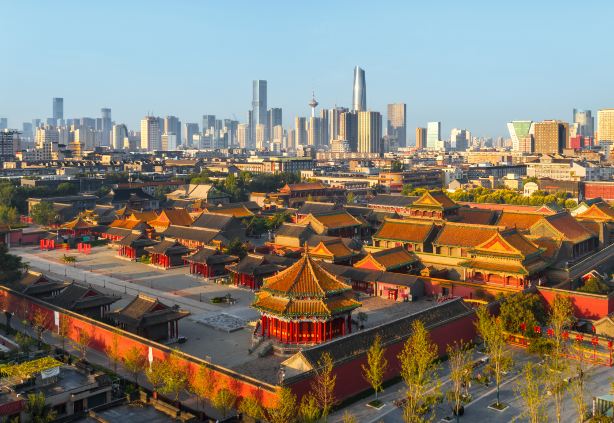
Shenyang Imperial Palace
Shenyang Imperial Palace is located in Shenhe District of Shenyang and is one of only two complete palace complexes that remain in China. It served as the imperial palace during the Later Jin dynasty, but became a regional palace after the capital of the Qing dynasty was changed to Beijing. Shenyang Imperial Palace Museum not only boasts exquisite ancient palace architecture, but also has a wealth of valuable items in its collections; there are, for example, a large number of relics left over from the old imperial palace. Shenyang Imperial Palace is divided into three parts according to the architectural layout and construction sequence: the eastern area is the portion built by Nurgaci, including Dazheng Hall; the central area is the portion built by Hong Taiji; and the western area is the portion built by Emperor qianlong, including Wenshuo Pavilion.China · Shenyang

Shenyang Fangcheng Cultural Tourism Area
Shenyang Fangcheng Cultural Tourism Zone is located in the center of Shenyang City. It is surrounded by Shuncheng Street in the east, west, south and north, with a total area of 1.69 square kilometers. It is a block with dense historical and cultural resources in Shenyang City, and it is also an area with concentrated historical and cultural relics in Northeast China. There are Shenyang Imperial Palace, a world cultural heritage, and Zhang Xueliang's former residence, a national key cultural relic protection unit, 7 provincial cultural relic protection units such as the Khan Palace Site, 9 municipal cultural relic protection units such as the Shengjing City Site (Northwest Corner Tower), 42 historical buildings such as the former site of the Governor's Office of the Three Eastern Provinces, 11 traditional stores such as Ma's Shaomai and Laobian Dumplings, 4 provincial intangible cultural heritages such as Shenyang folk traditional lantern riddles, Shenyang Hu Kuizhang pen making craftsmanship, Ma's Shaomai making skills, and Liao cuisine traditional making skills, and 16 municipal intangible cultural heritages such as Manchu pearl ball competition, Chen's metal relief craftsmanship, Li Liangui's smoked meat pancake traditional making skills, and Li Yongli's nuclear carving Attraction. Shenyang Zhongjie, which is known as the "No. 1 Street in Northeast China", is also a national demonstration pedestrian street.China · Shenyang

Jingyue Lake
Jingyue Pond (Crescent Pond) is a reservoir in the southeastern suburb of Changchun. It is known as the "sister lake of Taiwan's Riyue Lake". The groves of trees planted around the lake have become the largest forest park in Changchun. Walk through the forest paths to admire the trees, or stroll to the reservoir to look at the glimmering water and breathe in some fresh air. This is a great place to relax and unwind.China · Changchun
Free things to do in Huinan
Shenyang Fangcheng Cultural Tourism Area
China · Shenyang
Liaoning Provincial Museum
China · Shenyang
Northeast Nightless City
Meihekou · 33.7km from Huinan
Changchun Film Studio
China · ChangchunImmediate access, Book now for today, Cancel anytime
Zhongjie Street
China · Shenyang
Qipan Mountain
China · Shenyang
Lake Songhua Resort
China · Jilin City
Tianding Mountain Tourism Town
China · Changchun
The Hill
China · Changchun
The "9.18" Historical Museum
China · Shenyang
What travellers say about Huinan

天天星星点点22 July 2025
5.0
I went to Triceratops Bay more than ten years ago. It was very nice, cool, and there were few tourists.
I went there again more than ten years later, and there were even fewer people. Why don't people go to such a good place?
Changchun is too hot this year. It's so stuffy that I can't live. The whole family came to Triceratops Bay to escape the heat. It's so cool in the woods.
The scenic area is not big overall, the road is flat, and there are boats. There are several steep steps. Those who can't climb can choose not to go up. My mother waited for us to get down the mountain.
In fact, I feel that going to Triceratops Bay is not for sightseeing, but mainly for the good air and to breathe😃😃😃
Longwanqun National Forest Park of Jilin

D32***714 February 2025
5.0
The autumn scenery on the mountain during the National Day holiday is good, with colorful red, yellow and green colors, and the lake is beautiful. It is recommended to go there on a sunny day. Personally, I think the lake tour is average, the cost performance is not high, and there are many steps to climb after getting off the boat, which is a bit strenuous for the elderly
Triceratops Bay

Anonymous user7 October 2026
5.0
Sifangdingzi in autumn is truly worth a visit; the scenery is breathtaking, a blend of historical depth and natural beauty, offering a chance to explore its pristine charm. The shuttle bus zips along narrow roads, its swaying from side to side showcasing the driver's skill and years of experience. The driver offers helpful travel advice, and the uncles maintaining order will assist with carrying children—the warmth and hospitality of Northeast China are evident in every detail. Next time, I'd like to stay at a nearby hotel to experience the sunrise and sunset; it would be absolutely stunning.
Sifangding Scenic Area of Longwanqun National Forest Park

蓝溪镇9 June 2026
5.0
I go twice a year, during the May Day and National Day holidays. When I go in May, the mountains are ablaze with rhododendrons and the lake is emerald green—it's absolutely stunning. When I go in October, the mountains around the lake become a riot of color again. The green, yellow, and red leaves paint a picture, reflected in the deep blue lake, creating a serene and relaxing scene. Although there aren't many tourist attractions, I really enjoy the leisurely and stress-free pace of the trip, where I can appreciate the scenery without feeling tired.
Dalong Bay
Anonymous user3 October 2026
4.0
I visited Dalongwan and Diaoshuihu during the National Day holiday; the scenery was quite beautiful.
Diaoshuihu mainly features forest trails. It takes about 40 minutes to reach the waterfall. The waterfall isn't very big; to appreciate the scenery along the way, don't focus all your expectations on the waterfall itself.
Diaoshuihu Scenic Area
Anonymous user3 October 2025
5.0
During the National Day holiday, I brought my parents and children to the small town of Meihekou to visit the famous Zhibei Village. When I showed the old houses to the elderly, they were particularly moved. The old objects brought them back a lot of memories.
Zhibei Village
Anonymous user20 October 2026
5.0
As the National Day holiday drew to a close, I stepped through the vermilion gates of the Shenyang Imperial Palace. The red walls and yellow tiles shone brightly in the autumn sunlight. Unlike the grandeur of the Forbidden City in Beijing, this place exuded a rich Northeast Manchu flavor.
Upon entering the eastern section, the Dazheng Hall immediately caught my eye. This octagonal, double-eaved pavilion-style building resembled a giant tent. Two majestic dragon-carved pillars stood solemnly at the main entrance. The eight corners symbolized the Eight Banners, signifying "unity of the eight directions," forming a spacious tent-like courtyard with the ten princely pavilions arranged in a V-shape on either side. Standing there, one could almost see the grand scene of Nurhaci discussing politics with the leaders of the Eight Banners.
Continuing along the central axis, the Chongzheng Hall, golden and gleaming, stood in the center, commonly known as the "Golden Throne Hall." Its roof was covered with yellow glazed tiles with green trim, and the beams were shaped like three-dimensional dragons leaping forward. The interior was entirely open, without a ceiling. It was here in 1636 that Huang Taiji declared the change of the dynasty's name to the Qing Dynasty. Inside the hall, the gilded cloud and dragon screen and the openwork golden dragon throne are arranged according to the layout during Emperor Qianlong's eastern tour, giving visitors a sense of traveling through time.
Ascending the Phoenix Tower, once the tallest building in Shengjing (Mukden), one sees a plaque inscribed with Emperor Qianlong's calligraphy, "Purple Qi Comes from the East," hanging high above. From the railing, the entire Forbidden City unfolds before one's eyes.
During the National Day holiday, the Forbidden City was bustling with activity. The museum not only opened half an hour earlier and closed half an hour later but also offered nighttime tours. Folk music performances on the platform in front of the Dazheng Hall and tourists in ancient costumes strolling among the red walls gave this 400-year-old building a unique vitality during the holiday.
Marshal Zhang's Mansion Museum

ღ᭄ꦿ佳*佳🦊ོ20 October 2026
5.0
The park is much smaller than the Forbidden City in Beijing, and a leisurely stroll can take about two hours to see everything without the need for long walks. There are benches for resting throughout the park. However, elderly people in electric wheelchairs need to exchange them for manual wheelchairs at the service center. The Chongzheng Hall and the Five Palaces on the platform (the imperial concubines' residences) require climbing stairs and crossing high thresholds; the Phoenix Tower is a high-platform building, completely inaccessible to wheelchairs. Although there are accessible ramps in the Dazheng Hall Square and Wensu Pavilion area on the east side, most of the exhibition halls inside are inaccessible to wheelchairs, and most visitors can only view the exterior.
Shenyang Imperial Palace

半城烟雨半城笛8 August 2025
4.0
There were so many people and tourists that I didn't have time to take in many things. It's like a low-end version of the Forbidden City in Beijing. Many of the artifacts on display were discarded from the Forbidden City. Some rooms were off-limits, so people crowded around the entrances to take photos. There was no lighting inside, so the photos didn't look great. The architecture is still quite distinctive.
Shenyang Fangcheng Cultural Tourism Area

osa110420 October 2026
5.0
It's a bit far from downtown Changchun, about an hour's drive away. The automatic parking system at the entrance was a first for me, and it was free! There were even volunteers to show you how to use it – so thoughtful! The place is incredibly large; walking is impossible. A bus ride around it takes over 40 minutes. The most beautiful area is near the dam, not far from the entrance!
Jingyue Lake


