Hutubi

Things to do in Hutubi

Search attractions or local attractions & tours
Search

Explore top experiences

Top 10 attractions in Hutubi

View all Attractions
Kangjia Shimen Ziyanhua

Kangjia Shimen Ziyanhua

3
4.7/5
18 reviews

The Kangjia Shimenzi rock painting is a rare reproduction worship rock painting in China and the world. It is located in the hinterland of Tianshan Mountain in Hutubi County, Changji Prefecture, Xinjiang, on the Neogene siltstone wall on the northwest bank of the confluence of two mountain streams. The rock surface is flat, about 10 meters above and below the surface. The picture is 14 meters long from east to west, more than 9 meters high from top to bottom, and the entire area is about 120 square meters. There are two or three hundred figures and animals of different sizes and figures engraved on it. The larger one is 2.04 meters high, and the smaller one is 19 cm. There are males and females, standing or lying down, clothed or naked, male and female, two-headed and three-headed images. The rock paintings use the technique of bas-relief. The faces of the carved figures are all slender and long, with well-developed eyebrows, large eyes, high noses, and small mouths, with beautiful images. Wearing a high hat with feathers on his head, he dances. A considerable number of pictures show or metaphorize the action of male and female coitus. Under this image, there is also a scene of rows of villains dancing cheerfully, to express the wish to pray for the reproduction of offspring and the prosperity of the population. It truly embodies the group marriage life scene of primitive people praying for fertility and multiplying the population. On the rock wall less than 10 meters away from the left side of the rock painting, there is a cave that drips water all year round, which is called "Shenquan" by the local people.

Hutubi · 60.5km from downtown
Tianshan Tianchi
No. 2 of Best Things to Do in Xinjiang

Tianshan Tianchi

8.4
4.6/5
14.7k reviews

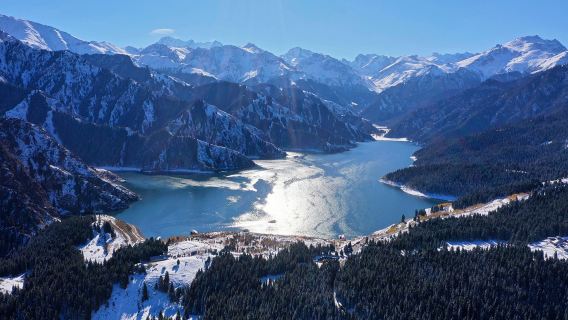
Tianshan Tianchi, also known as Tianchi National Geological Park and called "Yaochi" in ancient times, is located in Fukang, Changji Prefecture, on the northern side of Bogda Peak. It is approx. 110 km from Ürümqi and is a famous tourist destination in Xinjiang. In ancient Chinese mythology, Tianchi was also the bathing place of the Queen Mother of the West. Tianchi Lake sits at an altitude of 1910 m, with a maximum depth of 105 m. The lake reflects the Bogda Peak, surrounded by spruce trees, creating a fairy-tale-like scenery. The attraction encompasses natural views such as alpine lakes, wetland meadows, and forested canyons. In 2013, it was designated as a national geological park. When visiting Tianchi, don't just explore the lakeshore—you'll miss many surprising sub-attractions. Recommended hiking routes, lakeside pier - Haixi beach, lakeside pier - East small heavenly pool (Flying dragon pool) The Tianchi attraction features three water bodies: the main lake plus two others on its eastern and western sides. The eastern one is "East Xiaotianchi," also called Heilong Pool, located 500 m east of Tianchi. Below the pool lies a sheer cliff where a waterfall plunges down like a rainbow, giving the site its name "Hanging spring and jade rainbow." On the west side lies "West Xiaotianchi," also known as Jade Maiden Pool, located approx. 2 km northwest of Tianchi Lake. The pool, shaped like a full moon and encircled by towering pines, earned its poetic name "Dragon Pool under the jade moon" from the serene moonlit reflections on its surface. A waterfall cascades beside the pool, plunging dozens of meters like a silver river descending from heaven, dubbed the "Jade belt with silver curtain." Above the pool stands the Sound of Waves Pavilion, offering a unique vantage point to admire the waterfall. All attractions within the scenic area are connected by boardwalks, accessible on foot. On the eastern shore of Tianchi Lake stands the Temple of the Queen Mother of the West, originally built during the Yuan Dynasty. The current structure was reconstructed in 1999 on the original temple site, dedicated to the worship of the Queen Mother of the West, hence also known as the "Queen Mother Temple". It can be reached by hiking along the lakeside boardwalk (approx. 2 hrs) or by taking a cruise. The temple offers excellent views of Tianchi Lake. Maya Mountain requires taking a shuttle bus + cable car. The towering cliffs and numerous stone peaks present a breathtaking sight; from afar, they resemble a row of horse teeth, while looking up, they appear as if jagged rocks are competing in grandeur and stacked cliffs are vying in beauty, creating a mesmerizing view. This view of Maya Mountain is formed by rock weathering.The summit of Maya Mountain is relatively flat, featuring lush grasslands covered with butter grass in summer and dotted with colorful flowers. Standing here, you can take in the panoramic view of Heaven Lake to the north, while the Bogda Peak to the east and the snow-capped mountains to the south seem within reach. To the west, the farmlands on the outskirts of Urumqi are also clearly visible.

China · Fukang
The Xinjiang Museum
No. 1 of Family-friendly Attractions in Xinjiang

The Xinjiang Museum

7.7
4.8/5
2.4k reviews

The Xinjiang Museum is a comprehensive autonomous region-level museum in Xinjiang, located in downtown Urumqi. The building was fully unveiled in 2022 following renovation and expansion, with an architectural floor plan shaped like the Chinese character "he" (union). The museum's collection is noted for its textiles, paper documents, painted clay sculptures, and ancient mummy specimens. Permanent exhibitions include the "Exhibition of historical relics of Xinjiang," "The dead across a millennium—exhibition of ancient mummies in Xinjiang," "Treasures of the vast sea—exhibition of exquisite ancient costumes in Xinjiang," and "Historical records of China—exhibition of unearthed documents in Xinjiang." The main exhibition halls are concentrated on the second floor, while the third floor features special exhibitions such as musical instruments of the Silk Road. The museum has two signature highlights. First is the Han dynasty brocade armguard unearthed from the Niya ruins in Hotan, inscribed with the phrase "Five stars rise in the east, benefiting China," interspersed with cloud and animal motifs. This artifact is considered one of the masterpieces of Han dynasty brocade craftsmanship and is listed among China's prohibited overseas exhibition relics. Second is the mummy display: thanks to Xinjiang's arid climate, ancient corpses have been preserved for millennia without decay. Among them, the 3,800-year-old "Beauty of Loulan" is particularly famous. The same hall also displays the "Princess of Xiaohe" and the remains of General Zhang Xiong, a high-ranking military officer from the Gaochang Kingdom. Such permanent exhibitions are quite rare in domestic museums. You can start your visit with the historical artifacts exhibition on the second floor, which traces thousands of years of Xinjiang's history in chronological order, from the pre-Qin period through the Han, Wei, Jin, Sui, and Tang dynasties, to the Song, Yuan, Ming, and Qing dynasties. The exhibition hall covering the period from the Han to the Sui and Tang dynasties features a relatively concentrated collection of treasures. In the clothing exhibition, the red wool robe with human, animal, and tree patterns from the Yingpan cemetery displays a Hellenistic artistic style. The painted wooden figurine of the Heavenly King is carved and assembled from over thirty pieces of wood, with even the teeth being removable. The Old Uyghur "Maitreya-samiti-nataka" in the literature exhibition is also worth a close look. If you are sensitive to the subject of mummies or are visiting with children, you may want to check the exhibition content in advance and plan accordingly. The museum is a modern three-story building that also incorporates Xinjiang's architectural styles such as arched windows and domes, giving it distinctive features. It houses several permanent exhibition halls. The first floor features the Xinjiang ethnic customs exhibition and the ancient historical relics exhibition of Xinjiang. The second floor is divided into left and right sections: the left side contains the historical textiles exhibition hall and the "Forever with the Motherland" themed exhibition, while the right side displays ancient mummies and a white jade exhibition hall. Additionally, the museum frequently hosts temporary exhibitions and displays, which are worth visiting if available. The Xinjiang ethnic culture exhibition hall is located on the first floor, showcasing the folk customs of 12 major ethnic groups in Xinjiang, including the Uyghur, Kazakh, Mongolian, and Xibe peoples. Visitors can see displays of their musical instruments, daily necessities, yurts, and houses, as well as characteristic clothing like hats and scarves, most of which feature vibrant colors, embodying the distinctive ethnic charm of Xinjiang. A notable highlight is the Xibe people's houses. Since this ethnic group migrated from northeast China, their dwellings still feature the traditional northeastern heated brick bed (kang). Additionally, the furniture and tableware with Russian ethnic influences are also quite distinctive. The ancient historical artifacts exhibition of Xinjiang showcases a variety of unearthed relics from the Silk Road, spanning from ancient times to the present. It includes many Central Plains artifacts from the Han and Tang dynasties, which are highly characteristic of ancient Chinese culture. There are also numerous artifacts from the Western Regions, featuring murals with angelic figures and many objects unique to the Western Regions. These highlight Xinjiang's distinctive role as a bridge between East and West, making it an exhibition not to be missed. The mummy exhibition and the "Forever with the Motherland" exhibition on the second floor are the highlights of the museum. The mummy hall displays ancient corpses from thousands of years ago. Thanks to Xinjiang's arid climate, these bodies have been preserved from decay and are extremely precious. Among them, the "Loulan Beauty" mummy is one of the museum's top treasures. The "Forever with the Motherland" exhibition features precious cultural relics such as the "Five stars from the east" brocade and the seal of the Han-appointed Qiang chieftain. The "Five stars from the east" brocade is particularly valuable, and its legendary story is fascinating—definitely worth learning about.

Urumqi · 68.6km from Hutubi
Nalati Scenic Area
No. 4 of Best Things to Do in Northern Xinjiang

Nalati Scenic Area

7.9
4.5/5
3.8k reviews

Nalati Scenic Area is located in the heart of the Tianshan Mountains and the eastern end of the Ili River Valley, a subalpine meadow grassland formed on ancient alluvial deposits. Legend has it that when the westward-expanding Mongol army crossed mountains to reach this place, they suddenly saw a sunlit plain carpeted with flowers. The soldiers exclaimed "Nalati," which means "the place with sunlight" in Mongolian, giving the area its enduring name. The attraction integrates snow-capped mountains, forests, valleys, meadows, and rivers, primarily divided into several sections: the River Valley Grassland, Sky Grassland, Panlong Valley Trail, and Wolta Jiaota. Along the River Valley Grassland by the Gongnaisi River, visitors can find Tawusani (meaning "beautiful mountain valley" in Kazakh), ancient tombs from the Wusun people of the Han dynasties, and the Grassland Tribe recreating Wusun tribal life. Following the uphill ride on the mountain road leads to the Sky Grassland, a high-altitude meadow suspended among peaks. The Tianjie Terrace at the boundary between the valley and grassland offers expansive views, while Snow Lotus Valley at the trail's end is often shrouded in mist, with snow lotuses blooming in midsummer. The Panlong Valley Trail is a forest loop without backtracking, flanked by towering Tianshan spruces. The Wolta Jiaota section is ideal for hiking, with the Tianxian Terrace providing stunning views of sunrise above sea of clouds. From June to September each year, the grassland enters its golden season, with lush green pastures and blooming wildflowers everywhere. Kazakh herders drive herds of cattle, sheep, and horses into summer pastures, where scattered yurts and curling smoke create a picturesque scene. Visiting the attraction during this time allows you to ride horses, try archery, and dress in traditional ethnic costumes. You might also encounter traditional equestrian activities like horse racing, kokpar (goat grabbing), and kyz kuu (girl chasing), experiencing the authentic Kazakh nomadic culture between snow-capped mountains and meadows.

China · Xinyuan
World Mystery Town
No. 5 of Best Things to Do in Northern Xinjiang

World Mystery Town

7.7
4.3/5
5.7k reviews

World Mystery Town is located in the Gobi Desert on the northwestern edge of the Junggar Basin, and most travelers on the Northern Xinjiang loop route stop here along the way. This is a typical yardang landform, where prolonged wind erosion and water erosion have carved the Gobi into giant earth mounds of varying heights and shapes, resembling an abandoned ancient city from afar. The attraction sits right in a wind gap and is windy year-round, which is why locals also call it "Urho Wind City." There is even a saying: "One wind a year, blowing from spring to winter"—when strong winds pass through the crisscrossing gaps between the mounds, they emit shrill howls that sound like ghosts wailing at night, and this is how the name "Mystery Town" came about. In 2005, when *Chinese National Geography* held its "Beauty of China" selection for yardang landforms, this site was listed alongside the yardangs of Dunhuang and Lop Nur, making it one of the representative yardang views in China. The earthen mounds across the gobi resemble castle towers, while others look like people or animals. The attraction has given names to the most distinctive mounds, and the "sphinx" is one of the most popular sights among them. The attraction is quite large, and sightseeing is mainly done by riding the sightseeing mini train, which stops along the way at the sphinx, the filming location of "Seven Swords," the shooting spot of "Crouching Tiger, Hidden Dragon," Dinosaur Valley, and other stops, with a guide on board. Both the film "Crouching Tiger, Hidden Dragon" and the TV series "Seven Swords" were filmed here, and the stops retain sculptures restored according to movie scenes, so film fans can go stop by stop to find familiar images; Dinosaur Valley was built based on dinosaur fossils such as the Junggar pterosaur unearthed in Urho, and together with the oilfield experience area that reflects the history of local oil development, these two are content rarely found in other yardang attractions, and visitors can also experience riding a camel and taking photos in the attraction. The stay at each stop is limited, so if you have not taken enough photos, there is no need to rush for the train; just wait for the next one, and a full loop takes about two or three hours. At sunset, the slanting rays dye the earthen mound a warm gold, with distinct layers of light and shadow—the golden hour for photography. However, the Gobi has strong winds and sand, plus intense sunlight, so remember to bring windproof and sun protection gear and drinking water.

China · Karamay

Experiences you can't miss in Hutubi

Hutubi Today's weatherOvercast 1-11℃
Hutubi weather for the next 2 days11/11: 1-12℃, 11/12: 1-11℃

Free things to do in Hutubi

What travellers say about Hutubi

user-avatar
M93***4729 October 2024
5.0
The most beautiful time of Baili Danxia is from the end of June to the beginning of July. The grass is green and the scenery is the best at this time. The S101 highway is free throughout. From Urumqi Yaxin, the end of the road is the junction of Duku Highway. It takes 10 hours to walk and take photos.

S101 Hundred-Mile Danxia Viewing Platform

user-avatar
gz伊妹儿7 April 2020
5.0
The Kangjia Shimenzi Rock Paintings are also a place I visited last year. They are very beautiful, with unique rock paintings. They are very interesting and a good place for taking photos. The view is wide and the cost-effectiveness is very high. If you drive by yourself, the road is not easy to drive on.

Kangjia Shimen Ziyanhua

user-avatar
320***817 November 2026
4.0
Tianchi Lake in Tianshan is indeed less impressive compared to Tianchi Lake in Changbai Mountain. You don't need luck to see the entire lake, so the element of chance and anticipation isn't as strong. However, the scenery is undeniably beautiful and worth the ticket price. Even though it wasn't a holiday, it was still very crowded; there were queues for the shuttle bus, boat rides, and taking photos. There are also plenty of reasonably priced and delicious restaurants near the scenic area.

Tianshan Tianchi

user-avatar
M26***6326 September 2026
5.0
The guided tour experience at the Xinjiang Museum was top-notch! ✨ The guides were professional and engaging, providing a wealth of information and vividly recounting the history of the Silk Road. They explained the museum's most prized artifacts in detail, revealing many background stories not found in books. It was far more rewarding than visiting on your own. A guided tour is a must when visiting Xinjiang!

The Xinjiang Museum

user-avatar
M47***3327 February 2025
5.0
世纪园景区是一个多功能的休闲和娱乐的地方。

Hutubi Century Park Scenic Area

user-avatar
luck dog in31 October 2026
5.0
Narat Scenic Area, nestled deep in the Tianshan Mountains of Yili, Xinjiang, is a national 5A-level scenic area and a world-renowned alpine valley grassland. Its name in Mongolian means "the place where the sun first shines." The entire scenic area is mainly divided into three sections: the Sky Grassland, the River Valley Grassland, and the Panlong Valley. Snow-capped mountains, spruce trees, streams, and rolling meadows blend perfectly, creating a rich tapestry of landscapes where every snapshot is a magnificent scene. The Sky Grassland is expansive; from the Tianjietai (Heavenly Platform), one can see snow-capped peaks stretching to the horizon, scattered yurts, and grazing cattle and sheep. The River Valley Grassland is gentle and lush; from Tawusani, one can enjoy panoramic views of four different mountain ranges. The Panlong Valley trail winds through a deep forest, its ever-changing light and shadow creating a poetic atmosphere. The area is home to the Kazakh people, who have preserved their authentic nomadic customs, offering a variety of experiences including horseback riding, family visits, and camping. Wildflowers bloom everywhere from June to August, making it a great place to escape the summer heat; in autumn, the forests turn golden, creating another breathtaking scene. The scenic area is vast, so it's recommended to allow at least one day, pack warm clothes, and slowly savor the unique vastness and romance of the Tianshan grasslands. It's a must-see stop when visiting Yili.

Nalati Scenic Area

user-avatar
Karen晓喵29 October 2026
4.0
Located in Urho, Karamay, the World Devil City boasts unique and magnificent Yardang landforms, but opinions on this attraction seem to vary. We felt the overall experience was alright, and riding the little train through it at sunset was quite enjoyable.

World Mystery Town

user-avatar
毛哥牛逼9 June 2026
4.0
It's a great place to experience the rich ethnic culture of Xinjiang. The architecture is very unique, and the atmosphere is especially wonderful when the lights come on at night. The food, handicrafts, and song and dance performances are all quite local. If it's your first time visiting Xinjiang, it's definitely worth a visit. However, the area is quite commercialized, and many goods and restaurants are on the expensive side. I suggest you shop around and compare prices before making any purchases. It's better to treat it as a place to experience local culture and take photos.

Xinjiang International Grand Bazaar

Trip Moments in Hutubi

Popular cities near Hutubi

Frequently asked questions

You can give Urumqi cultural 1-day tour | Akhal-Teke horse show + Xinjiang museum + Grand bazaar and New Oriental Express high-end tourist train: Altay, Aksu, Hotan, Changji, Xinjiang cuisine, crossing the Western Regions a try. Before you go, please check their opening hours and menus online. Reservations are recommended, especially during peak hours.

Get help anytime, anywhere within 30 secondsContact customer support

Change and cancellation policies vary by attractions and tours. Please check the product details page for more information.

Ticket prices may vary between weekdays and weekends, as well as during peak and off-peak seasons. When booking with Trip.com, you can also use Trip Coins to get extra savings. For more tips on booking discounted tickets, please visit Trip.com for the latest information.