OverviewReviewsWin PrizesTrip MomentsDetailsNearbyRecommended
Share to
Show all
St. Augustine's Church
聖奧斯定堂
2.2
4.6/5
102 reviews
 based on 85 reviews
Open Opening hours of St. Augustine's Church
Free entry
Recommended sightseeing time: 1–2 hours
Address:
2 Largo de Santo Agostinho, Macao
Map
Phone:Ticket inquiry: +853-28510331
St. Augustine's Church attraction highlights
Some information may have been translated by Google Translate
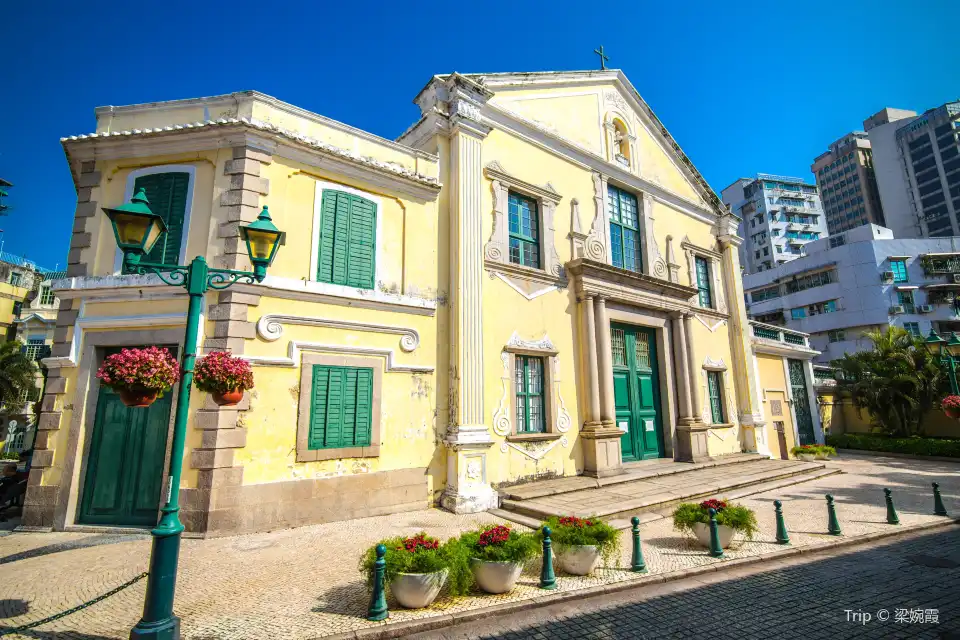
St. Augustine's Church in Macau was built by the Italian Catholic Church and the St. Augustine Church when they came to Macau to preach in 1586. It was owned by the Portuguese three years later. It was the first church in Macau to preach in English. The church was rebuilt in 1825, with a magnificent and majestic appearance, spacious interior decoration, and a statue of Jesus carrying the cross on the altar made of marble. The front wall of the church is divided into two layers, and there are triangular mountain flowers on the top. Two ancient Greek-style granite columns separate the two sides of the gate. The main column inside divides the church into three ways and supports its vaulted roof. There are various legends about St. Augustine's Church. It is said that when the statue is taken to the cathedral by the church officials, it will magically return to the altar of St. Augustine's Church. Therefore, the statue is still in place. In the 16th century, when Western missionaries began to preach in Macau, they built several churches. In the eyes of the Chinese at that time, religious buildings were called "temples". St. Augustine's Church in the front of Gangding was very crude when it was first built. Whenever it rained, the priests covered the roof with palmetto leaves to keep out the wind and rain. The church was called "Longxu Temple", and later it was renamed "Longsong Temple" or "Longgong Temple" in Cantonese pronunciation. Therefore, the street next to the church was called Longsong Street. From the "temple" at that time to the "church" later, it reflects the integration of Chinese and Western in Macau, and it is everywhere in every corner. After the opening of Macau as a port, Western missionaries used Macau as the first base for spreading their messages into China, so Macau is called the "City of Holy Names". Missionaries living in Macau come from Portugal, Spain, Italy and other countries. Most of their Masses are in Portuguese or English. They also preach in Cantonese in response to Macau residents. St. Augustine's Church is the first to preach in English. church. Since the establishment of the Macau Diocese in the 16th century, Macau has been carrying on this tradition - the parade of the suffering Jesus statue from February 12th to February 13th. The parade lasted for two days. On the first day, the image of the suffering Jesus carrying the cross solemnly departed from St. Augustine's Church in Gangding and was welcomed to the cathedral. The icon remained in the cathedral to receive prayers. The next day, the priests carried the image of the suffering Jesus on a trip, and then returned to St. Augustine's Church. The parade of the suffering Jesus statue is one of the important festival activities of the Macau Catholic Church.
St. Augustine's Church Reviews: Insider Insights and Visitor Experiences
Write a review
St. Augustine's Church Photos: Trip Moments
 The heart of the Macau PeninsulaSituated on a gentle hill in the heart of the Macau Peninsula, St. Augustine's Square (Largo de Santo Agostinho) represents one of the most serene and visually captivating corners of the UNESCO-listed Historic Centre of Macau. Paved with traditional wave-patterned Portuguese mosaic cobblestones (calçada), this idyllic enclave beautifully illustrates the rich fusion of Southern European heritage and subtropical East Asian landscape. The photographs highlight Calçada de Santo Agostinho, a picturesque, steeply sloping lane characterized by rugged granite retaining walls, classical lamp posts, and ancient banyan trees whose overarching canopies cast soft shadows across the stone path. Dominating the upper slope is the famous Dom Pedro V Theatre (Teatro Dom Pedro V), distinguished by its pastel mint-green facade, neoclassical arcade, classical columns, and white-balustraded terrace. Erected in 1860 by the Macanese Portuguese community to honor King Pedro V, it holds the distinction of being the first Western-style theater in East Asia. Serving as a cultural epicenter for generations, it has hosted operas, grand balls, and civic gatherings, preserving European artistic traditions in the region. Directly opposite stands St. Augustine’s Church (Igreja de Santo Agostinho), founded by Spanish Augustinian friars in 1591. The church presents a classical pale-yellow exterior accented by vibrant green wooden doors, louvered shutters, and an understated triangular pediment crowned by a cross. Strolling down this quiet incline offers an enchanting step back in time, far removed from Macau’s bustling modern high-rises and neon-lit entertainment resorts. The timeless atmosphere, pastel-hued Mediterranean architecture, and leafy surroundings reflect the enduring historical synergy that defines Macau’s cultural landscape. As a vital sanctuary of history and architecture, St. Augustine's Square stands as a testament to centuries of cross-cultural encounter and harmonious heritage preservation.Explore.Ram2

 World cultural heritage—St. Augustine's Church📍Hidden spot in Macau|This “Dragon Whisker Temple” is stunning beyond words… Who would have thought! This pale yellow church I stumbled upon at Largo do Santo Agostinho really has more atmosphere than the Ruins of St. Paul’s!!✨ This is St. Augustine's Church, also called “Longsung Temple” by locals. The name has a fun origin🤣 Back then, Spanish friars used palm leaves to cover the roof. When the wind blew, the leaves fluttered like dragon whiskers, giving it this cute nickname~ 💛About its beauty The exterior walls are a soft, gentle pale yellow, paired with white scroll decorations. Every photo looks like a vintage film scene🎞️ Inside is even more breathtaking! It has a classic basilica layout, with two rows of columns stretching the space deeply. The floor is patterned tile, the pulpit is wooden, and light streams through the windows. At that moment, your heart feels calm…🕯️ ✝️Special experience This church houses the statue of the suffering Jesus. If you visit during Easter, you might witness the famous “statue procession,” a major religious event in Macau that is very solemn and sacred. ☕️Nearby activities After visiting the church, sit on the steps at Largo do Santo Agostinho and relax. Nearby are the Teatro D. Pedro V and the Sir Robert Ho Tung Library. You can visit Macau’s three most artistic spots in one go without getting tired! 📌Practical info: ▫️Address: No. 2 Largo do Santo Agostinho (no need to search hard, it’s just up the slope diagonally opposite the Civic and Municipal Affairs Bureau) ▫️Admission: free🆓 ▫️Opening hours: 10:00 AM–6:00 PM ▫️Tips: Remember to keep quiet inside. This is an active church, not just a tourist spot~JacksonMitchell


- макао
- китай
- путешествие
Architecture in Macau.I absolutely love the European-style buildings here. They are so beautiful. I feel like stopping at every single building to admire the details. It’s like putting a puzzle together—you see one piece, then another, then a third, and before you know it, you’re hooked. Being in Macau, I personally want to pause at every corner and soak it all in with my own eyes. And then, of course, take tons of photos 😅 I really don’t understand how people can visit Macau just for a day. It’s impossible to see everything, let alone truly experience the atmosphere.Sandra_AT

- 澳門快閃
- 澳門行程
- 澳門景點
- 澳門打卡
- 澳門歷史古蹟
St. Augustine's Church in Largo de Santo Agostinho, Macau.Located in Largo de Santo Agostinho (St. Augustine's Square), there stands a church officially known today as St. Augustine's Church, though locals historically referred to it as "Long Song Temple". From a distance, you'll notice its main structure is a beautiful beige. If you stroll up the sloping alleyway and head around to the side, you'll discover a church dating back to 1591. Over the course of more than 400 years, it has slowly evolved from a modest structure with a fan palm-leaf roof into the stunning classical building you see today. It is one of the oldest churches in Macau and forms part of the Historic Centre of Macao, inscribed as a UNESCO World Heritage site in 2005. The sunlight bathes the yellow exterior walls in a warm glow, creating a peaceful harmony with the tranquil square. Upon entering the church, two rows of stone pillars elegantly divide the space, leading your eyes to the solemn and majestic statue of Jesus carrying the cross at the main altar. I absolutely love the serenity here. If you're looking for a quiet escape from the hustle and bustle of Macau, you should definitely drop by and sit for a while. 📍St. Augustine's Church 2 Largo de Santo Agostinho, Macaujxjeminixj
 How to "Travel the World" During a 4-Hour Macau Layover.If you're transiting through Zhuhai to Yunnan and have a morning to spare in Macau, where should you go? ? It feels like Portugal in September... wait, no, it's Macau While many places are cooling down, the Greater Bay Area is still scorching hot 🔥🔥🔥 Since I was traveling with family members who hadn't visited Macau in 15 years and we only had from noon until the afternoon, I picked the fastest route to soak in the Portuguese vibes 🌏 Right after crossing the Border Gate, head straight to Kam Fook Lung Portuguese Steakhouse for some authentic Macanese cuisine—it's delicious! From there, Senado Square and the Ruins of St. Paul’s are just a stone's throw away ✨ Next, walk behind Senado Square towards St. Augustine's Square and St. Augustine's Church. This area is a hidden Portuguese-style gem with fewer crowds and stunning architecture. Afterward, head downhill past the police station to the Chao Van Market (Lower Bay Market), where you can experience the local Cantonese atmosphere. From there, you can hop on the MT4 bus back to Gongbei 🚗 If you have a 4-hour layover in Macau while transiting through Zhuhai, check out this easy walking route for a taste of Portugal 🏃花蓮博愛泊心境小陸2


- staugustine
- macau
- macautravel
- catholicchurch
- macauhistory
Centuries of Macau after Failing China Missions -- The St. Augustine's ChurchFollowing the footsteps of the first Catholic missionaries, the Jesuits, the Augustinians also made their way to Macau in the 1580s. Other Catholic missionaries that came around the same time were the Dominicans and the Franciscans. Unlike the first Jesuits that arrived in Macau with the specific goal of ministering the Portuguese population there, the first Augustinian priests in Macau were of Spanish origin. They were the fathers from Manila in the Philippines, who were looking to do missions in China. Before the rise of Hong Kong as a British colony in the 1840s, Macau was deemed the doorway to China. But even then, Macau as the entry point to the establishment of Catholic Augustinian missions in China was considered a last resort to the Spanish Augustinians. Like the Portuguese, the naval power of the Spanish fleets overwhelmed that of some of the more difficult pirates. It was with the defeat of Chinese pirate Ly Ma Hon in 1574 at Luzon that the Spaniards thought presented the opportunity for them to extend their ecclesiastical reach into China. However, they failed miserably in approaching the official authorities for the approval to set up their missionary bases in China. When the Chinese resolutely refused their requests, the Spanish Augustinians returned to Manila. They handed over the administration of their mission in Macau to the Portuguese Augustinians. The very first St. Augustine’s Church was established by the Spanish Augustinians in 1591. At the time, the church building was very modest. Its roof being reinforced with Chinese fan-palm, it often wavered in the wind like the whiskers of a dragon, as such the Chinese people called it “Temple of the Long-Whiskered Dragon (long song miu).” The current Augustine’s Church is a structure of 1814. At the time, the Portuguese Augustinians had long taken over the Spanish Augustinians in the administration of the mission in Macau. In terms of its appearance, the St. Augustine’s Church features neoclassical elements of architecture, with just a tiled and gabled roof, no dome, and one tower. Overall, its style reflects the spirit of the Renaissance. Its façade features prominently two pairs of Doric granite columns with a triangular pediment at the top. Its interior is designed in the basilica style. The beauty of the St. Augustine’s Church is in the simplicity itself, its chief significance being of historic, cultural and ecclesiastical in nature. #staugustine #macau #macautravel #catholicchurch #macauhistoryHelen Yu (Chestnut Journal)

- 澳門旅行
- 全球旅行
Macau St. Augustine's Church: Historical and Cultural Heritage, Serene Worship EnvironmentMacau St. Augustine's Church is a Baroque-style church with rich historical and cultural heritage, built in 1728. Its interior design blends European religious art with local characteristics, and the colors used are very representative of Macau. The church's arched windows allow natural light to gently pour in, complementing the interior decorations and creating a serene worship environment. The overall design not only reflects the sanctity of religion but also embodies artistic beauty, making it one of Macau's important cultural assets.worldtravellover

- heritagechurches
- macautravel
- portuguesefood
Galo" (Cock) is a local Portuguese mascot. Over 30 years ago, the founder, a retired Portuguese naval officer, fell in love with Macao—a coastal city much like his homeland—and decided to settle here. He established Estabelecimento de Comidas Dom Galo (Dom Galo) to bring authentic Portuguese flavours and traditions to Macao. Since its opening in 1987, Dom Galo has been a beloved fixture in Macao for over three decades, renowned for its genuine and distinctive Portuguese cuisine. It has not only won the hearts of locals but also attracted repeat visitors from abroad. Recommendations: Seafood Rice in Galo Style; King Prawns with Cream and Curry Sauce; Stewed Oxtail in Red Wine; Roasted Pig in Portuguese Style; Clams in Navy Style; Baked Sea Bass in Portuguese Style; Codfish in the Oven Address Shops AF-AG, G/F, Vista Magnífica Court, Avenida Sir Anders Ljungstedt, Macao St. Augustine’s Church in Macau offers a serene, deeply peaceful vibe. Located in St. Augustine's Square(Largo de Santo Agostinho), it features a pastel-yellow neoclassical exterior, cobblestone surroundings, and a quiet atmosphere just a short walk from bustling Senado Square. Atmosphere and Surroundings · Quiet escape: Far less crowded than northern tourist spots, making it ideal for reflection or a slow stroll. · Portuguese charm: Surrounded by traditional cobblestone lanes, old gas lamps, and historic European-style buildings. · Square seating: Benches in the shaded square invite visitors to sit outside, breathe fresh air, and relax. Inside the Church · Warm and solemn: Features a bright yellow and white interior with classic stone columns and gentle light. · Sacred focal point: Houses the striking statue of Bom Jesus dos Passos at the main altar. · Multilingual welcome: Holds quiet prayer spaces and regular services in multiple languages including English, Portuguese, Cantonese, and Tagalog #heritagechurches #macautravel #portuguesefoodNatania Chaviva1
 St. Augustine's ChurchSt. Augustine's Square is an important square in the Historic Center of Macau, connecting many important and artistically valuable buildings. 🌈One of these is St. Augustine's Church, which was built in 1591 and was the first church in Macau to preach in English. 🌟In 1874, St. Augustine's Church was renovated to its current appearance.Garcia Sophia8Sophia


- 澳門景點
Macau St. Augustine's Church | A Timeless Mark of FaithHey everyone👋, in Macau, there's a church with over 400 years of history—St. Augustine's Church—that's absolutely worth exploring! Originally built in 1588 by Spanish Augustinian friars as a monastery and the Chapel of Our Lady of Grace, the church dedicated to the Virgin Mary began construction in 1591. It was once known in Chinese as "Long Song Temple," a name with an interesting story behind it. In 1623, a governor sent by the Portuguese court clashed with the local community and sought refuge in the church. Angered, the locals fired cannons from the Fortaleza do Monte, destroying the church. The friars covered the ruins with palm leaves, which swayed in the wind and resembled dragon whiskers from afar, hence the name "Dragon Whisker Temple," later changed to "Long Song Temple." After being rebuilt in 1874, the church took on its current form, facing south with a simple façade standing about 17 meters tall, designed in the classical style of the European Renaissance. Inside, two rows of columns divide the nave and side aisles, with the nave featuring a small altar and a wooden pulpit. The main altar houses a statue of the "Christ of Sorrows," adorned with ornate Baroque-style decorations. The Procession of the Christ of Sorrows, which starts and ends at St. Augustine's Church, is a significant event during Lent before Easter. This Catholic tradition has been practiced in Macau for centuries without interruption, further enhancing the church's reputation. Step inside and experience the unique charm where history and faith intertwine~Genlyddy
Additional information
Surrounding area map of St. Augustine's Church
Attractions near St. Augustine's Church
Show more

Hotels near St. Augustine's Church
Show more
Restaurants near St. Augustine's Church
Show more
Stores near St. Augustine's Church
Show more
Trip.com picks
Popular cities in China
Popular Macau Tours
Best Macau Experiences
Popular Destinations
Things to do in JiuzhaigouThings to do in SuzhouThings to do in ShanghaiThings to do in SanyaThings to do in BeijingThings to do in YulongThings to do in TaipeiThings to do in HarbinThings to do in ChongqingThings to do in ZhuhaiThings to do in DujiangyanThings to do in QingdaoThings to do in YangshuoThings to do in ChengduThings to do in Shenzhen
Must-see House of Dancing Water + Figure-8 Ferris Wheel | Macau self-guided tourMacau Black Sand Beach + Rua de Cinco de Outubro + Fisherman's Wharf Macau self-guided tour | The house of dancing water show + Studio City Water Park round-trip free shuttle busMacau private charter Macau 1-day tour 7 seater luxury Alphard/medium bus private charter pure play customizedMacau Ruins of St. Paul's + Lotus Square + Fisherman's Wharf Must-see Macau House of Dancing Water + Golden Reel Figure-8 Ferris Wheel | Macau self-guided tourDiscovery more Macau evening food tour with city tour by locals Macau Venetian + Rua Do Cunha + Macau Tower Departing from Guangzhou | Macau world heritage skyline private 1-day tour | Chinese-English-Korean-Japanese guides availablePrivate Charter from Hong Kong to Macau: 1-Day Tour to Ruins of Saint Paul's, The Venetian, and Rua Do CunhaPrivate chartered tour from Zhuhai Chimelong Ocean Kingdom to Macau Macau Travel ServicesMacau Connectivity SolutionsMacau Airport ServicesMacau ActivitiesMacau SIM CardMacau Day ToursMacau TransportationMacau Spa & MassageMacau Yacht CharterMacau Boat TicketsMacau Restaurant DiscountsMacau Bus TicketsWellness & Spa in MacauMacau Shopping DiscountsMacau Transport CardThings to do in ShanghaiThings to do in BeijingThings to do in Hong KongThings to do in OsakaThings to do in ZhangjiajieThings to do in SingaporeThings to do in ChongqingThings to do in TokyoThings to do in GuangzhouThings to do in Xi'anThings to do in ChinaThings to do in JapanThings to do in ThailandThings to do in VietnamThings to do in South KoreaMore recommendations
Popular Types of Attractions in Macau
Popular Restaurants in Macau
La Chine | Imperial Court | Five Foot Road | The Eight | SW Steakhouse | Wing Lei | Churchill’s Table | Palace Garden | Pearl Dragon | Le Buffet | The Manor | Chan Kwong Kei BBQ Shop | The Grand Buffet | Mesa by José Avillez | Nam Ping Cafe | Drunken Fish | Jade Dragon | 8½ Otto e Mezzo BOMBANA Macau | Chiado | Guincho a Galera | ALBERGUE 1601 | ZI YAT HEEN | Gordon Ramsay Pub & Grill | Margaret's Café e Nata | Luk Kee Noodle | WONG CHI KEI | Fernando's Restaurant | Lai Heen | Feng Wei Ju | Spotlight
Popular Destinations
Zibo Travel | Kortrijk Travel | Canela Travel | Cascade Travel | Changbai Mountain North Slope Scenic Area Travel | Tawe-Uchaf Travel | Niagara-on-the-Lake Travel | Lezhi Travel | Savoie Travel | Prospect Travel | Thibodaux Travel | Anxi Travel | Broxbourne Travel | Alacati Travel | Bethlehem Travel | Quedlinburg Travel | Mackinac Island Travel | Gottingen Travel | Blue Mountains Travel | Campbell County Travel | Guadalupe County Travel | Rishikesh Travel | Boljoon Travel | Mercer County Travel | Cocoa Beach Travel | Ningming Travel | Opcina Zadar Travel | Cetinje Travel | Windham County Travel
Recommended attractions at popular destinations
Popular Attractions in Bangkok | Popular Attractions in City of Manila | Popular Attractions in Tokyo | Popular Attractions in Taipei | Popular Attractions in Hong Kong | Popular Attractions in Seoul | Popular Attractions in Kuala Lumpur | Popular Attractions in Los Angeles | Popular Attractions in Shanghai | Popular Attractions in New York | Popular Attractions in Shenzhen | Popular Attractions in Osaka | Popular Attractions in Singapore | Popular Attractions in London | Popular Attractions in Guangzhou | Popular Attractions in San Francisco | Popular Attractions in Beijing | Popular Attractions in Macau | Popular Attractions in Bali | Popular Attractions in Jakarta | Popular Attractions in Paris | Popular Attractions in Ho Chi Minh City | Popular Attractions in Istanbul | Popular Attractions in Phuket | Popular Attractions in Chicago | Popular Attractions in Seattle | Popular Attractions in Toronto | Popular Attractions in Orlando | Popular Attractions in Cebu | Popular Attractions in Chiang Mai
Popular Ranked Lists
Top 20 Global Traveller-Picked Attractions in Kunming | Top 50 Global Traveller-Picked Restaurants in Dalian | Top 20 Global Traveller-Picked Hotels in Qingyuan | Top 20 Global Traveller-Picked Restaurants in Qinhuangdao | Top 50 Global Traveller-Picked Restaurants in Hangzhou | Top 10 Global Traveller-Picked Attractions in Leshan | Top 20 Global Traveller-Picked Restaurants in Wuyuan | Top 50 Global Traveller-Picked Restaurants in Haikou | Top 50 Global Traveller-Picked Hotels in Hangzhou | Top 50 Global Traveller-Picked Restaurants in Shanghai | Top 50 Global Traveller-Picked Hotels in Shanghai | Top 20 Global Traveller-Picked Attractions in Shaoxing | Top 50 Global Traveller-Picked Attractions in Xiamen | Top 10 Global Traveller-Picked Attractions in Urumqi | Top 50 Global Traveller-Picked Attractions in Beijing | Top 10 Global Traveller-Picked Attractions in Shangri-La | Top 50 Global Traveller-Picked Hotels in Sanya | Top 20 Premium Hotels in Jinan | Top 20 Global Traveller-Picked Restaurants in Jingdezhen | Top 20 Global Traveller-Picked Hotels in Zhuhai | Top 50 Global Traveller-Picked Restaurants in Shenyang | Top 50 Global Traveller-Picked Attractions in Nanjing | Top 50 Global Traveller-Picked Hotels in Chongqing | Top 50 Global Traveller-Picked Hotels in Chengdu | Top 20 Global Traveller-Picked Attractions in Wuxi | Top 20 Global Traveller-Picked Attractions in Guiyang | Top 20 Global Traveller-Picked Restaurants in Lanzhou | Top 20 Global Traveller-Picked Hotels in Zhongshan | Top 20 Premium Hotels in Taiyuan | Top 20 Premium Hotels in Yangzhou
Trending Travelogues
Popular Trip Moments
Portucau: Macau’s Must-Try Dining Spot 🍽️✨ | Zhuxiandong Reservoir Guide: A Hidden Water Source Secret in the City | Radiance Through the Ages: A Millennial Journey into the Art of Liuli. | You'll love it more the longer you stay. It's all suites, and you'll be hooked the moment you walk in. Who could say no? | Can the streets of Macau become a racetrack? | Explore Seac Pai Van Park in Macau! | TeamLab Supernatural Space Macau Review: A Stunning Family-Friendly Spot for Photos | Thai Food Cravings: Papermoon Restaurant in Taipa Macau 🇹🇭🍜 | A Must-Try Portuguese Taste in Macau | Chiado by a Michelin-Starred Chef. | Took the family for our second trip to Jiuzhaigou. We arranged two hotels for our 5-day, 4-night stay, following our visits to the Hotel Indigo in Macau and Changsha | The House of Dancing Water at City of Dreams Macau: A Must-See, Stunning Water Show | Macau Trip | Macau's Elite 5: The Most Luxurious Suites Guaranteed to Wow Even the Seasoned Traveler | Experience the feeling of staying in a European palace at this top-tier luxury hotel in Macau | Explore Macau Fisherman's Wharf! | New top-tier luxury in the Greater Bay Area, bringing Lingnan intangible cultural heritage to Jiulong Lake | Staying in Zhuhai for a concert, I discovered a hidden gem of a classic garden hotel | Hyatt Regency Hengqin Zhuhai | A hidden gem for trips to Macau and Chimelong | Explore the Roman Amphitheatre at Macau Fisherman's Wharf! | A Chapel and Lighthouse Above Macau 🌤️ | Unboxing THE KARL LAGERFELD Macau! Scored a Free Upgrade to a Regal Chinese Palace Room ✨ | Nov 6, 2026, Macau outfit reality check—don't believe everything online... | The Dazzling "Luminous Glass" Exhibition. | Macau photo guide is here!!! Girls, save this post~ Must-visit | The honest truth! I took the whole family to Macau without spending a dime on admission tickets! | A 2,150 sq. ft. Luxury Suite for Families of Six in Macau | Hengqin ticket stubs can be used like cash! | This castle hotel in Macau is absolutely stunning | Encountering London Under the Glass Dome: A Day Trip to The Londoner Macao | This Macau Hotel Feels More Like a Romantic Date Than a Typical Vacation!
More Things To Do in Macau
Global (77 Countries) 5G/4G eSIM | Supports Google Maps/TikTok/ChatGPT | Total Data Plan | 24-Hour Billing | 1–30 Days | QR code | Mainland China · Hong Kong · Macau 5G eSIM | 6 Carriers · All AI & TikTok | 1–365 Days | QR Code | Mainland China/Hong Kong/Macau 5G eSIM | 5 Carriers | Day Pass/Total Data Package | 24-Hour Billing | QR Code | Asia 10 Regions 5G eSIM | Multi-Network • All AI Supported | 1–30 Days | QR Code | Mainland China/Hong Kong/Macau/Taiwan 5G/4G eSIM | Supports Google Maps / ChatGPT | Daily/Total Data Plans | 24-Hour Billing | 1–30 Days | QR Code | Asia-Pacific eSIM | 5G/4G | High-speed data | Daily data/data plan | 24-hour service | 1-30 days | QR code | Orange World 4G/LTE eSIM | Calls + SMS | 31 Days Total 50MB–20GB | Calendar-Day Billing | QR code | TurboJet Ferry Ticket - One Way (Hong Kong Sheung Wan to/from Macau Outer Harbour) | TurboJet Ferry Tickets - Hong Kong Sheung Wan to/from Macau Taipa (Optional: One-way Tickets) | [15% off for two] Cotai Water Jet (Hong Kong Sheung Wan to/from Macau Taipa) two one-way boat tickets | Cotai Water Jet (Hong Kong Sheung Wan to/from Macau Taipa) two-way one-way boat ticket | Asia 10 regions & Australia/New Zealand 4G/5G eSIM | Daily plan / total data | 1-30 days | Charged by 24 hours | QR code | Global 77 Countries 4G/5G eSIM | Day Pass/Total Data Package | 24-Hour Billing | QR Code | Macau 5G eSIM | All AI Supported | 1–30 Days | QR Code | Mainland China/Hong Kong/Macau 4G/5G eSIM | Daily Package/Data Package | 24-Hour Billing | QR Code | Buffet breakfast at Spotlight in Studio City Hotel Macau | [Hong Kong - Macau Express] Hong Kong Tsim Sha Tsui China Hong Kong City Station <—> Macau Venetian | Round-trip and one-way bus tickets | Macau private charter transfer◉Private charter from Macau to Foshan Chancheng, Zumiao, Shunde Qinghui Garden Hotel, Hong Kong | Professional driver + point-to-point door-to-door transfer + cross-border licensed van + convenient clearance | Professional cross-border car service for Macau/Hong Kong clearance | Hong Kong, Macau - Shenzhen, Zhuhai, Guangzhou, Foshan, Zhongshan, Jiangmen | Point-to-point door-to-door transfer | Preferred choice for relatives travel and business reception | Shenzhen-Hong Kong private charter direct service, cross-border transfer with Hong Kong-Shenzhen dual license shuttle van | Macau SKY 21 Buffet Lunch Voucher [Buy 3 Get 1 Free] (Valid only on Mondays and Thursdays) xc | Departing from Hong Kong and Macau - Private Charter Services Across Guangdong Province | Shenzhen/Dongguan/Guangzhou/Foshan/Zhongshan | 7-Seater Business Van Transfers, Charged Per Vehicle | Macau Galaxy [CHA BEI] Dinner for 2 Set Menu | Hong Kong - Macau|Hong Kong Metropark Hotel Mongkok (Prince Edward) to Macau MGM Cotai (via Hong Kong-Zhuhai-Macau Bridge) [Cross-border Business Shuttle with Fixed Departure Schedule] | Macau [Studio City W Hotel] set meal (Hawker Hawker buffet / DIVA / Blind Tiger / Living Room) | Cross-border transfer in the Guangdong-Hong Kong-Macau Greater Bay Area, Hong Kong transfer service - Macau dual license plate vehicle cross-border transfer private charter, Shenzhen/Guangzhou/Macau/Zhuhai/Hong Kong Island urban area hotel port transfers | Cross-border private charter service for Hong Kong and Macau - round-trip between Hong Kong/Macau and Shenzhen/Zhuhai/Guangzhou/Foshan with exclusive vehicle clearance channel to avoid holiday crowds, no need to disembark for Hong Kong-Macau border clearance | Macau Studio City selected lounge (duo package + specialty cocktails + scenic wine tasting + optional 38 lounge or Lan bar) | Macau Studio City - Spotlight buffet | Unlimited global gourmet feast + gorgeous Art Deco setting, delicious and photogenic | Macau Kyoto Hotel Dim Sum Lunch Buffet - 2-Hour All-You-Can-Eat
Some content is uploaded by users, and specific information is subject to actual conditions
Other visitors' reviews of St. Augustine's Church
Show More ReviewsTravel Notes of St. Augustine's Church in Macau St. Augustine's Church in Macau is a historic Catholic church. It was built in 1591 by Spanish Augustinian monks. We also came to this church during our Macau historic tour. The original architecture of St. Augustine's Church was very simple. The monks at that time covered the roof with palm leaves to protect it from wind and rain. Whenever a strong wind blew, the flying palm leaves stood up like dragon whiskers, so the Chinese called it "Dragon's Beard Temple". Now the church has been built into a regular Western-style building, but we can still imagine the original simple scene. Walking into the interior of the church, the magnificent altar forms a sharp contrast with the ancient walls. The church still retains 16th-century stone carvings and tombstones of early monks. Those Latin inscriptions record the most original history of this church. Standing in the former "Dragon's Beard Temple", my thoughts can't help but drift to the time and space hundreds of years ago. At that time, the Augustinian monks, with firm faith, spread the gospel on this land of Macau. Today, this church has become a witness to this religious history.