Things to do in Beizhen
Explore top experiences
Top 10 attractions in Beizhen


Beizhen Today's weatherClear -3-6℃
Beizhen weather for the next 2 days11/10: 0-11℃, 11/11: 1-15℃
Free things to do in Beizhen




What travellers say about Beizhen

妮彩雨彩8 June 2026
5.0
Who else has been a loyal fan for 17 consecutive years? Me? Haha 😃 A journey of tranquility. Stepping through the mountain gate, I felt inexplicably at peace. The air was fresh, the environment was beautiful, everything was wonderful. Seeing Qingyan Temple getting better and better these past few years makes me so happy 😁 May we all get better and better 👌🏻
Qing Yan Si

halen80167 October 2026
5.0
We hiked on October 6th. It wasn't crowded. Children's tickets need to be purchased on-site at the scenic area. There were many performances and interactive programs, which were quite interesting and provided a great experience. There's no cable car, and the mountain isn't high or steep, making it suitable for both the elderly and children. We hiked at a leisurely pace, starting at 9:30 am and ending at 2 pm, including rest and lunch time. The glass walkway costs 30 yuan per person separately, and parking is 20 yuan per vehicle with no time limit. There are also some private parking lots outside the scenic area for 5 or 10 yuan.
Yiwulü Mountain

M30***905 October 2026
5.0
I finally got to ride the super fun roller coaster, it was so exciting! It was so exhilarating! The line for rafting was incredibly long during the holiday, I waited for over an hour before it was my turn, which was a little disappointing, but it was worth it!
Daluhua Yunyansi Scenic Area
花旅行纪念册26 November 2024
5.0
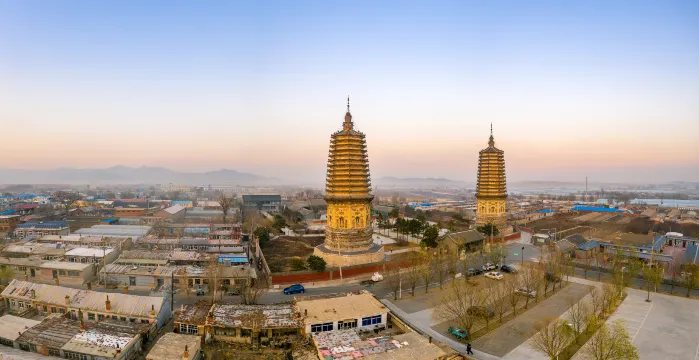
The twin towers of the Liao Dynasty are free to see.
The 13-story solid tower with dense eaves has a statue of Bodhisattva in the niche of the tower, two attendants and two flying gods, a canopy, and a lotus seat, which is a typical Liao tower shape.
Behind the tower is Chongxing Temple, a temple rebuilt in the Ming and Qing Dynasties, and the main hall is the old one.
There are several stone elephants moved from other places on the west outer wall of the temple, which add a bit of ancient charm to the ancient tower of the temple.
Except for the inconvenient transportation, it is really recommended!
Twin Pagodas at Chongxing Temple

老刘一直在路上2 February 2025
5.0
The "Five Mountains and Five Towns" are like natural sketches, outlining the contours of ancient China. The temples of the Five Sacred Mountains are still prosperous today, but among the temples of the Five Towns, there are very few ancient buildings of any scale that can still be seen. However, the Beizhen Temple at the foot of the Yiwulü Mountain was once glorious due to the enshrinement by successive Qing emperors, and it also left behind a treasure trove of mountain-guarding culture.
✨The Sanlu doctor chanted the poem "I set out from Taiyi in the morning and arrived at Weilu in the evening", and Wulv Mountain, the town of Youzhou, became a synonym for the end of the world.
💫Beizhen Temple, the third national temple, the existing buildings are relics of the Ming and Qing dynasties. The temple is ranked among the top national protected sites because it is the only remaining ancient building among the Wuzhenshan temples, and the huge number of inscriptions is very rare in the Northeast.
✨The mountain gate is three bays wide and has a single-eaved hip roof. The plaque "Beizhen Temple" in the Ming Dynasty is said to be written by Yan Song. There are four stone lions around the archway outside the mountain gate, each with a different expression, which is quite interesting.
💫Walking through the Shenma Temple, you can see four stele pavilions lined up in a row, staggered and orderly (Figure 1). These four pavilions contain four imperial steles from the Qing Dynasty, which are testaments to the three Qing emperors, Kangxi, Yongzheng and Qianlong, who worshipped Beizhen Mountain. However, the pavilion was severely damaged, and the stone tablet inside was pulled and broken in the 1970s, and the writing is slightly scattered.
✨In front of the Imperial Fragrance Hall, which is directly opposite the stele pavilion, there are many steles, most of which were written by Emperor Qianlong, with some from the reign of Emperor Kangxi. However, the themes are quite unified, all of which are poems and essays praising King Guangning, the god of the Medical Wulv Mountain. The Qing emperor believed that the Jianzhou Jurchens’ entry into the pass was inseparable from the protection of Beizhen Mountain. It is understandable that the Qing Taizu once served under Li Rusong in Guangning City and had a reverence for this famous mountain that was passed down from generation to generation. Not only did the three emperors Kangxi, Yongzheng and Qianlong favor Beizhen Mountain in their hometown, but even Jiaqing and Daoguang also left inscriptions on Yiwulü Mountain.
💫The main hall is five bays wide and three bays deep, with a single-eaved hip roof. The statue of Prince Guangning in this hall was rebuilt in recent years, but the murals of Thirty-two Heroes of the Ming Dynasty around the hall, although they underwent a certain degree of restoration in the 1980s and 1990s, have generally maintained the style of Qing Dynasty murals. Moreover, the murals use portraits of real meritorious officials as the theme, which is rare among many temple murals (Figures 13-16). There are also some Yuan Dynasty inscriptions hidden here.
✨The last one is the sleeping hall, which is second only to the main hall in size. It is now used to exhibit the works of Beizhen calligraphers and painters.
💫A large area of ruins can be seen in the east of Beizhen Temple. This is the Beizhen Guangning Palace where Emperor Qianlong stayed many times. His love for Yiwulü Mountain is evident. In the lush grass, the hundreds of years of connection between Beizhen and Qing history can be recalled. Looking west, the long Yiwulü Mountain shows its pale blue body under the dark clouds. The legend of this mysterious Youzhou town mountain spans It has survived the Warring States Period, the Liao and Qing Dynasties, and is still revered by people in Northeast China today. It can be said to be a legend in the mountain culture.
Beizhen Temple

可爱的旅游生活8924 September 2025
5.0
The highlight is that it has a natural oxygen bar with extremely high negative oxygen ion content, with thousand-year-old Chinese pine trees and various plants everywhere, beautiful natural scenery, and scattered Liao Dynasty stone carvings, ancient temples and other cultural relics. You can drive up the mountain, which is friendly to different groups of people.
Liaoning Yiwulü Mountain National Forest Park

M77***699 November 2026
5.0
A Grand Marshal's Mansion, Half a History of the Republic of China
When visiting Shenyang, the Zhang Family Mansion is an unmissable cultural landmark. This national 4A-level scenic spot and key national cultural relic protection unit holds the weight of a century of modern history in Northeast China, and encapsulates the legendary lives of the Zhang family father and son. A stroll through it is like turning the pages of a thick history book of the Republic of China, immersing visitors in the dramatic and turbulent years of modern China.
The entire mansion complex blends Chinese and Western architectural styles, achieving a harmonious balance of movement and tranquility, with an elegant layout that exudes grandeur. The central courtyard is a typical three-courtyard siheyuan (traditional courtyard house) from the late Qing Dynasty to the early Republic of China. Its ancient and dignified features include blue brick walls and black tiles, exquisite hanging flower gate towers adorned with colorful wood carvings of flowers, birds, and auspicious beasts, and vermilion pillars paired with elegant door piers, showcasing the exquisite grandeur of northern official architecture. The courtyards progress in layers: the first courtyard for offices, the second for receiving guests, and the third for living quarters. The orderly layout recreates the living scene of an old official residence, with old furniture and household items inside bearing the marks of time.
The most iconic building in the park is the majestic Grand Green Building, a Romanesque-style brick structure that once stood as the highest point in Fengtian (Shenyang) during the Republic of China era. Its Western-style columns and arched windows are perfectly blended with Chinese relief patterns, showcasing a unique fusion of Chinese and Western craftsmanship. The Tiger Hall inside is particularly famous, with two tiger specimens standing silently, witnessing a pivotal turning point in the military and political history of Northeast China. Scenes such as Zhang Xueliang's office and banquet hall have been meticulously recreated, with weathered murals and retro furnishings silently recounting major historical events such as the two Zhili-Fengtian Wars and the Northeast Flag Change, allowing visitors to truly experience the real military and political past of the Republic of China.
The adjacent Small Green Building is elegant and exquisite, the residence of Zhang Zuolin's fifth wife. This unassuming and gentle building carries untold family stories, and the historical events of the Huanggutun Incident add a profound sense of tragedy to it. The former residence of Zhao Yidi, nestled nearby, is refreshingly elegant. The two-story French-style building is warm and tranquil, with its fully restored study and bedroom quietly bearing witness to the legendary romance between the Young Marshal and Miss Zhao Si, adding a touch of gentle warmth to its rich history.
The accompanying financial museum is particularly worth a visit. The former site of the Bianye Bank recreates the entire layout of a Republic-era bank, featuring hundreds of lifelike wax figures, retro counters, and a giant vault, vividly recreating the financial scene of the Republic of China era. The attention to detail is remarkable, creating a highly immersive experience.
The entire tour is worthwhile. Here, there is no noisy commercial atmosphere, only a profound history and rich cultural heritage. Every brick and tile tells a story, every courtyard and building tells a legend, making it perfect for visitors who appreciate history and culture to explore at their leisure.
Marshal Zhang's Mansion Museum
Trip Moments in Beizhen


Popular cities near Beizhen


Frequently asked questions
How can I contact Trip.com customer support?
Get help anytime, anywhere within 30 secondsContact customer support
Can I change or cancel my booking?
Change and cancellation policies vary by attractions and tours. Please check the product details page for more information.
How can I get discounted prices?
Ticket prices may vary between weekdays and weekends, as well as during peak and off-peak seasons. When booking with Trip.com, you can also use Trip Coins to get extra savings. For more tips on booking discounted tickets, please visit Trip.com for the latest information.