China Visa-Free Transit 2026: 24/240-Hour Rules, Countries & Ports

Contents
- China’s Visa-Free Transit Policies at a Glance
- What Is the 240-Hour Visa-Free Transit Policy?
- Which Nationalities Qualify for 240-Hour Transit?
- Europe (40)
- Americas (6)
- Oceania (2)
- Asia (9)
- Which Cities and Ports Allow 240-Hour Transit?
- How to Use 240-Hour Transit Without a Visa
- What you can and cannot do
- 24-Hour Visa-Free Transit
- Can you leave the airport?
- What if the connecting flight is the next day?
- Visa-Free Transit Rules You Must Follow
- Country A and Country B must differ
- Separate tickets
- Hotel check-in
- Delays and missed departures
- Who Does Not Qualify?
Show more
China operates two principal transit-without-visa options in 2026: a widely available 24-hour rule and a 240-hour program for 57 nationalities at 65 designated ports. Both require genuine onward travel to a third country or region.

(Source: Google)
| Question | 24-hour transit | 240-hour transit |
| Nationality | All nationalities in principle | 57 listed nationalities |
| Maximum stay | 24 hours | 240 hours / 10 days |
| Route | A → China → B | A → China → B |
| Ports | All ports open to foreign travelers | 65 designated ports |
| Leave the restricted port area? | Only with a temporary entry permit | Yes, within the approved activity area |
| Work or study? | No | No |


The policy allows eligible ordinary-passport holders to enter mainland China without obtaining a visa in advance while traveling onward to a third country or region. The basic pattern is Country/Region A → mainland China → Country/Region B, and B must differ from A.
Hong Kong, Macao and Taiwan are treated as separate regions for this itinerary test. London–Shanghai–Tokyo can qualify. London–Shanghai–London cannot. London–Shanghai–Hong Kong can qualify, subject to all other conditions.
The NIA’s policy page updated August 20, 2026 states that eligible travelers may use any of 65 listed ports in 24 provincial-level regions and remain within the approved activity area for no more than 10 days. Permitted activities include tourism, business, visits and family visits. Work, study and journalism require prior visas or approvals.
Albania, Austria, Belarus, Belgium, Bosnia and Herzegovina, Bulgaria, Croatia, Cyprus, Czechia, Denmark, Estonia, Finland, France, Germany, Greece, Hungary, Iceland, Ireland, Italy, Latvia, Lithuania, Luxembourg, Malta, Monaco, Montenegro, Netherlands, North Macedonia, Norway, Poland, Portugal, Romania, Russia, Serbia, Slovakia, Slovenia, Spain, Sweden, Switzerland, Ukraine and United Kingdom.
Argentina, Brazil, Canada, Chile, Mexico and United States.
Australia and New Zealand.
Brunei, Indonesia, Japan, Kyrgyzstan, Qatar, Singapore, South Korea, United Arab Emirates and Vietnam.
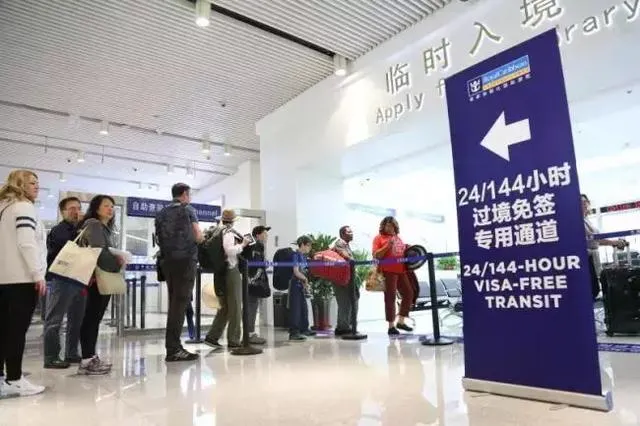
144-hour visa-free transit policy had already been extended to 240-hour visa-free transit policy now.
(Source: Google)
The program covers designated ports in Beijing, Tianjin, Hebei, Liaoning, Shanghai, Jiangsu, Zhejiang, Anhui, Fujian, Shandong, Henan, Hubei, Hunan, Guangdong, Hainan, Chongqing, Guizhou, Shaanxi, Shanxi, Heilongjiang, Jiangxi, Guangxi, Sichuan and Yunnan.
Major gateways include Beijing Capital and Daxing, Shanghai Pudong and Hongqiao, Guangzhou Baiyun, Shenzhen Bao’an, Chengdu Tianfu and Shuangliu, Hangzhou Xiaoshan, Nanjing Lukou, Xiamen Gaoqi, Qingdao Jiaodong, Wuhan Tianhe, Xi’an Xianyang, Chongqing Jiangbei, Kunming Changshui, Harbin Taiping, Haikou Meilan and Sanya Phoenix.
ALL 65 OFFICIAL PORTS

(Source: Google)
- Build a valid route. The place immediately after mainland China must differ from the place immediately before it.
- Check nationality and passport. The program is for ordinary-passport holders from the 57 listed countries.
- Select eligible ports. Entry and exit need not be the same port, but both must be listed and the itinerary must remain inside approved areas.
- Confirm the onward ticket. Carry a booking with a fixed date and route leaving China within 240 hours.
- Notify the carrier. Ask the airline, rail or ship operator to verify the transit arrangement at check-in.
- Apply at border inspection. Follow the 240-hour transit signs and present the passport, onward ticket and accommodation details.
- Follow the endorsed deadline. The date and time recorded by the border authority control.
Tourism, ordinary business visits, exchanges and visits to relatives or friends are allowed within the approved area. Employment, degree study, journalism and activities requiring prior governmental approval are not.
China applies 24-hour visa-free transit at all ports open to foreign travelers, in principle for citizens of all countries. The traveler needs a valid international travel document and a confirmed onward ticket on an international aircraft, ship or train to a third country or region. The entire mainland-China transit must remain within 24 hours.
Only with permission. Travelers who remain in the port’s restricted transit area do not complete normal entry. Anyone who needs to collect baggage landside, change airports, use a landside hotel or visit the city must apply to border inspection for a temporary entry permit. It can be refused.
An overnight connection can qualify if the entire transit fits inside the authorized period. Confirm whether baggage is checked through, whether the terminal remains accessible overnight and whether a temporary entry permit is needed.

(Source: Google)
The rule does not require arrival and departure from the same country—it requires the opposite. New York–Beijing–Tokyo may qualify; New York–Beijing–New York does not. A domestic connection before leaving China remains part of the China segment and must use eligible ports and stay within the permitted area.
Separate bookings are not expressly forbidden, but they create practical risk. You must show the entire confirmed itinerary, meet baggage and terminal requirements, and persuade the first carrier that Chinese border inspection will admit you.
A hotel stay is allowed after entry under the 240-hour policy or after the 24-hour traveler receives a temporary entry permit. Hotels normally register foreign guests. A traveler staying at a private home must complete accommodation registration with local police within 24 hours.
Contact border inspection or the local exit-entry authority immediately if cancellation, illness or force majeure may prevent timely departure. A disrupted flight does not silently extend the authorized stay.
Visa-free transit removes the advance-visa requirement. It is not an unconditional right to board or enter: the carrier decides whether to transport the traveler, and Chinese border inspection makes the admission decision.

(Source: Google)
Popular recommendations

Most Beautiful Natural Landscapes Around the World
 Trip.com